


[Note: Ryan is joining me tomorrow for Let’s Do Lunch, on the Contrarian website at noon ET! We’ll answer listeners’ questions and talk AI bubbles, bond yields, vibes gap, etc.—JB]
A Consensus is Building
In an analysis released last month, we estimated that the big-spending hyperscalers need $13-$18 trillion in revenues over the next 10 years to justify their AI-infrastructure investments.
This is, by definition, speculative work, requiring judgment calls on technical aspects of the analysis, such as discount rates, depreciation schedules, taxes, and revenue paths. So, we were happy to see that several other analysts and researchers have, independently, been working on the same problem. Callum Williams of the Economist, whose produced his own excellent analysis on the topic, put together a comparison of these different estimates, including ours.
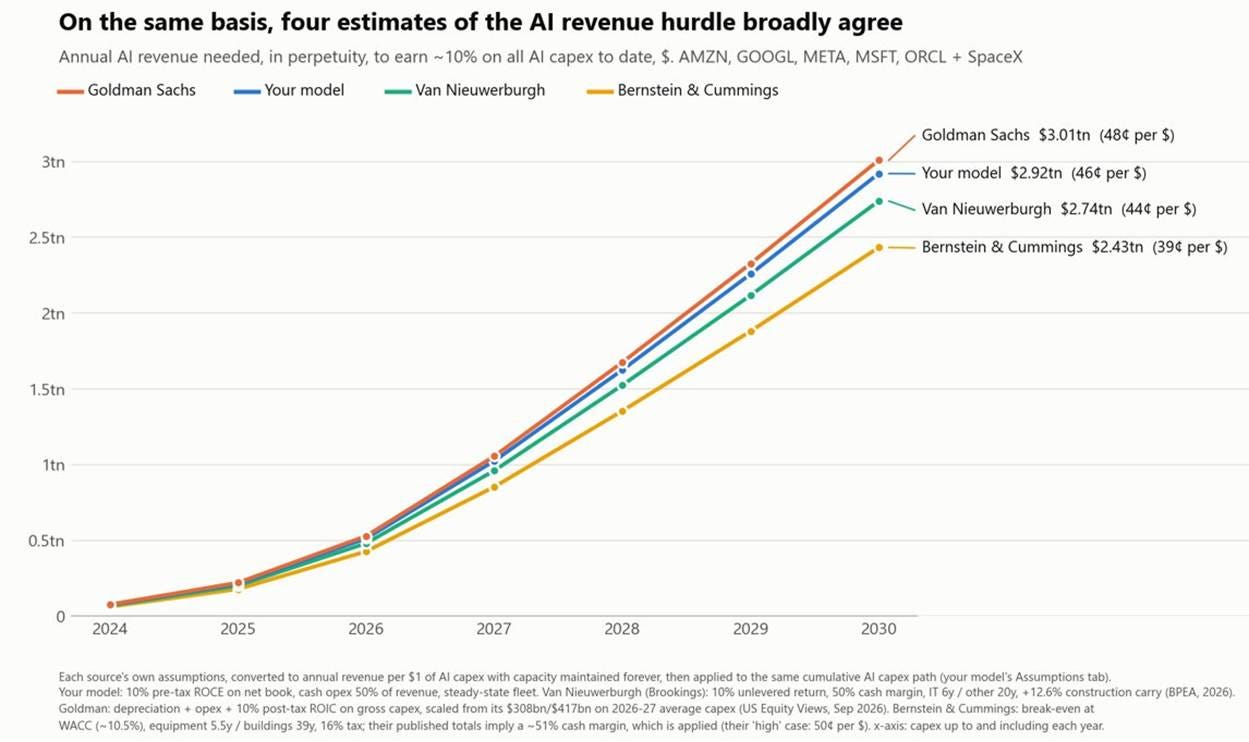
Turns out we’re pikers! But what’s striking is how close each of the estimates are: firms will need between $2.4-3.0 trillion in annual incremental AI revenues by 2030 to justify their big spending; this is about 5-6 times more than they are currently making under the most general possible assumptions.
They may clear that hurdle. Eventually. But as one of us (Ryan) told Axios:
“Can all these people eventually turn this into something profitable? I think they will…I’m not sure who’s going to do that, but I do think there will be trillions of dollars of profits that are up for grabs in the future, but just not in this super-accelerated timeline that is required to justify the investments.”
Lab IPOs
Last Monday night, the IPO prospectus of Anthropic was leaked to Reuters, revealing profitability (or lack thereof) details which we, and several others, have been trying to track.
Anthropic is a member of the AI ecosystem referred to as “the labs,” i.e., firms that train frontier AI models. Along with OpenAI, it is uniquely interesting for examining the profitability of the AI industry because unlike the hyperscalers, whose steep road to profitability is evident in the figure above, the labs are making a pure AI play. They don’t have other business segments that make profits outside of AI, thereby muddying the calculation of how much of the firm’s overall revenues are being made through AI. Instead, 100% of the firms’ operating profits (or losses) are from AI.
It’s thus revealing when pieces of information about the finances of these two firms become public, as with Anthropic last week, and OpenAI, whose financials were leaked in June. Here again, the absence of profitability—in these cases, steep operating losses—is not encouraging and underscores our overarching thesis that the sector is in the throes of a financial bubble.
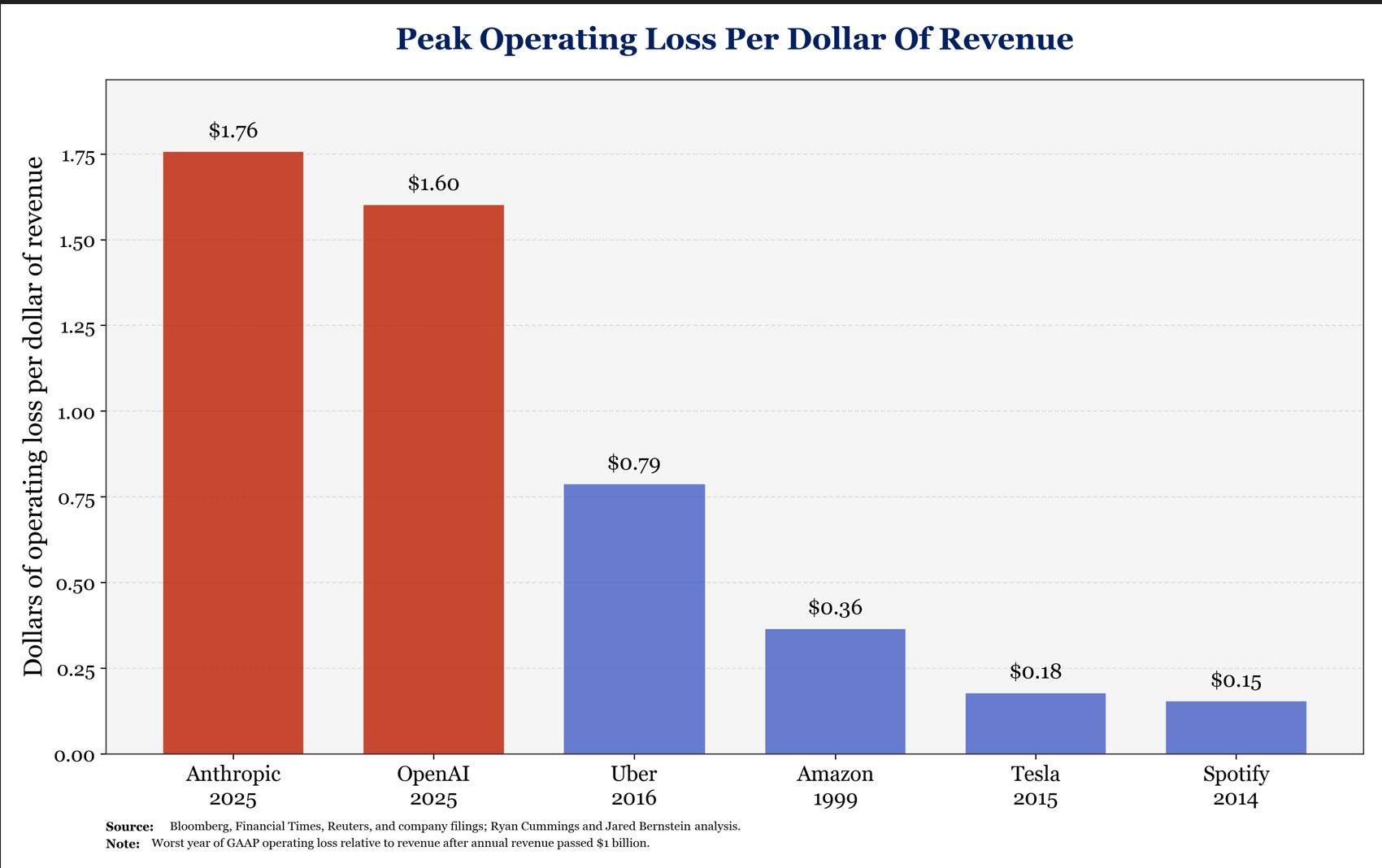
AI optimists argue that many firms that went on to be successful—Amazon, Uber, and Tesla—lost money for years before starting to make it. But what the leaked financials reveal to us is that both the speed and scale of the losses this time are dramatically different. The chart below shows that last year, Anthropic and OpenAI lost more than $1.76 and $1.60, respectively, for each dollar of revenue they brought in. This was more than double Uber’s in 2016 and more than five times Amazon’s in 1999.
The extent of the losses so far is also historically notable. The next figure shows how long it took different companies to move from (cumulative) losses to gains. OpenAI and Anthropic, at least so far and based on what we can see, are in a class by themselves, with OpenAI having lost roughly 75 percent in one year of what Uber lost over the course of eight.
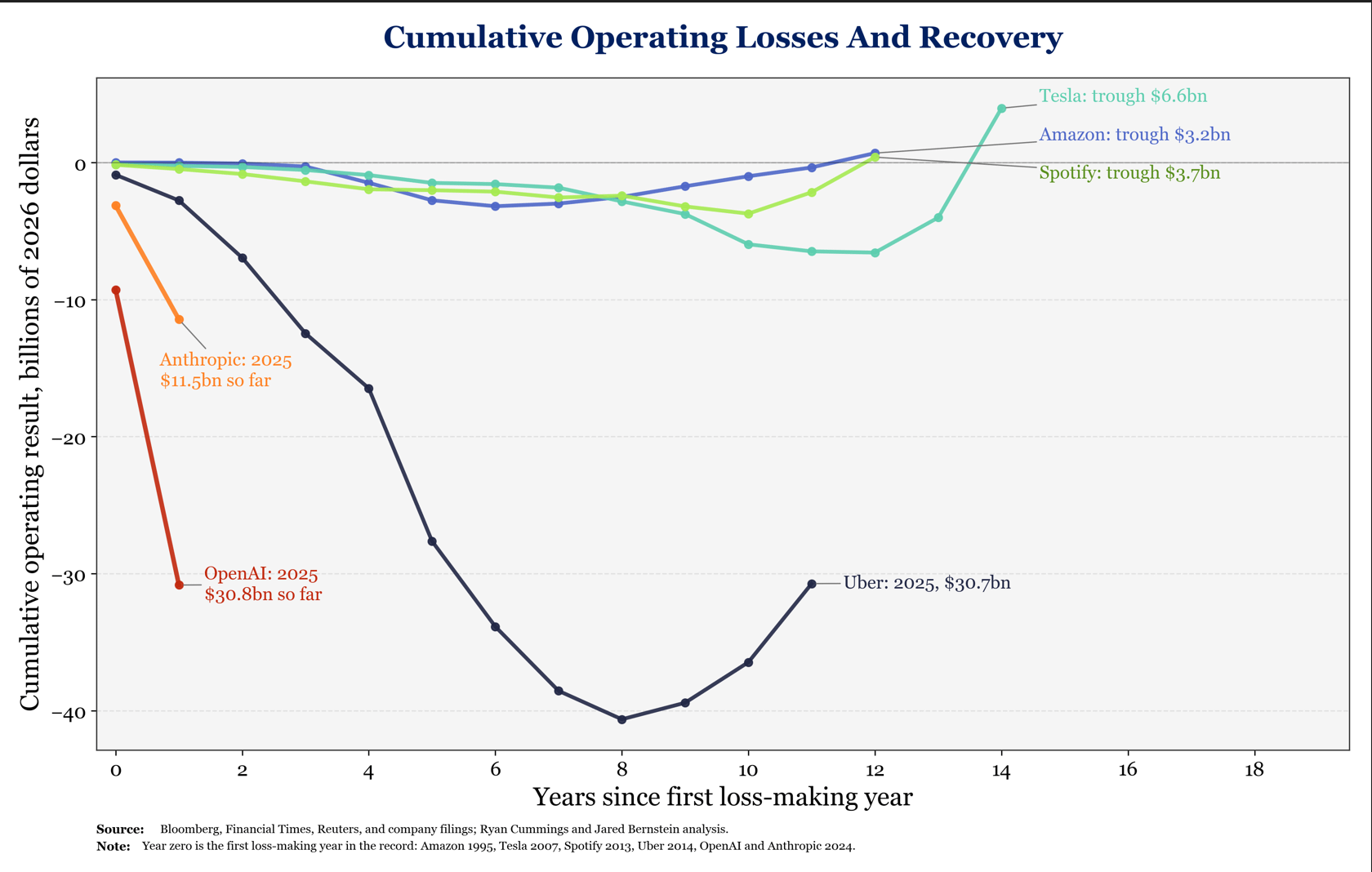
For all their prominence in AI debates, the labs also may lack a strong competitive position that would lead to large profits. They own little of the infrastructure that powers them, and it’s far from clear that they can develop and sell the enterprise models necessary to reverse their tanking lines in the figure above. Businesses still appear unsure about the return on spending large amounts of money on subscriptions to the labs’ products, and firms are starting to cut back on AI spending. Part of this entails large firms like AT&T switching more to open-source models, which are (for now) free.
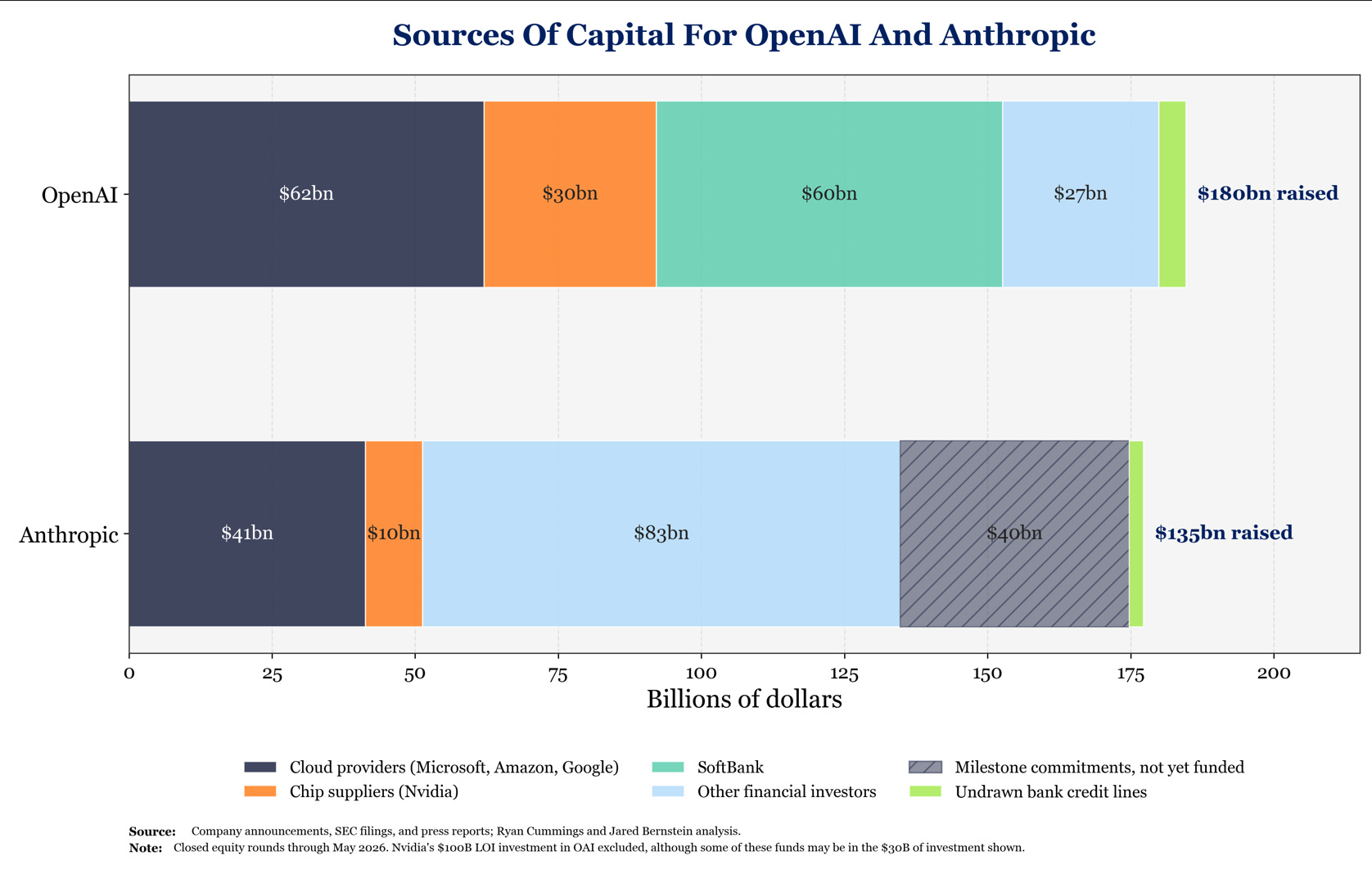
Moreover, unlike the hyperscalers, the labs don’t have other (highly profitable) business segments which can wholly or largely subsidize their activities. Google, for example, can largely pay for Google DeepMind (its own AI lab), its chips and datacenters, out of its advertising profits. But OpenAI and Anthropic don’t have that lifeline, requiring them to raise equity (or issue debt, which so far they have largely avoided).
The figure below highlights this feature, showing that in addition to equity raises, the firms have also received large amounts of financing from other AI firms (some of the hyperscalers and Nvidia), which again highlights the fragility of the entire arrangement—if one or both of the labs gets their lunch eaten by the much-cheaper open source models, then not only will the demand for the hyperscalers’ compute shrink, but their non-operating income from their stakes in the labs will fall meaningfully.
As we always say in this work, none of these bubble concerns lead us to doubt the potential of this powerful, new tool to transform many aspects of our economy and labor market—for better or worse is to be seen—while generating a meaningful acceleration in productivity growth. But our work, and now that of others deriving similar findings, strengthens our view that AI is in a financial bubble. If we’re right, and depending on how quickly investors pull back, this probably-a-bubble will have negative implications for the broader economy. Which is fodder for our next piece in this series.
What was left out of this well-written article is the 500 billion of liabilities that anthropics filing showed of which about 400 billion is firm contractual liabilities. If you add this to the approximate $900 billion of firm contractual liabilities of open ai, you arrive a figure of about 1.3 trillion.
The 1.3 trillion of liabilities is supporting the approximately 3 trillion of liabilities of the hyperscalers.
So it's just not less revenues to the hyperscalers. It will also cause a financial chain reaction of epic proportions because there's hundreds of billions of private credit loans that are being supported by the two cash burning machines.
Interestingly, 1.3 trillion is approximately the amount of subprime loans that were outstanding prior to the financial crisis.
The difference is that only about 15% of these subprime loans actually were defaulted on, whereas when the two cash burning machines default, the entire 1.3 trillion of liabilities will be defaulted on
The ripple effects in the financial markets and the economy will be huge
It's hammers and chef's knives. Erik Brynjolfsson proved PC gains required organizational capital—training, redesign—often 10x hardware costs. Today's AI repeats this mistake but in exponential terms: we're building durable data centers (hammers) for disposable GPUs (chef's knives degrading every 2-3 years), without factoring in restructuring how organizations work. We're investing trillions in infrastructure while skipping the expensive organizational transformation that actually drives productivity. In a world of screws, we will mostly have hammers.