

I’ve been remiss in not revisiting conditions in the US housing market.
Not totally remiss, as I’ve often commented, in the affordability context, on the sharp increase in the 30-yr fixed-rate mortgage, shown below. That’s a consequential price increase: the median home right now costs about $400,000 (make that $3.5 mil in Palo Alto, from where I’m writing). Going from the pre-war sub-6% rate to today’s 7.4% adds over $3,000 in annual financing costs.
THIRTY-YEAR FRM
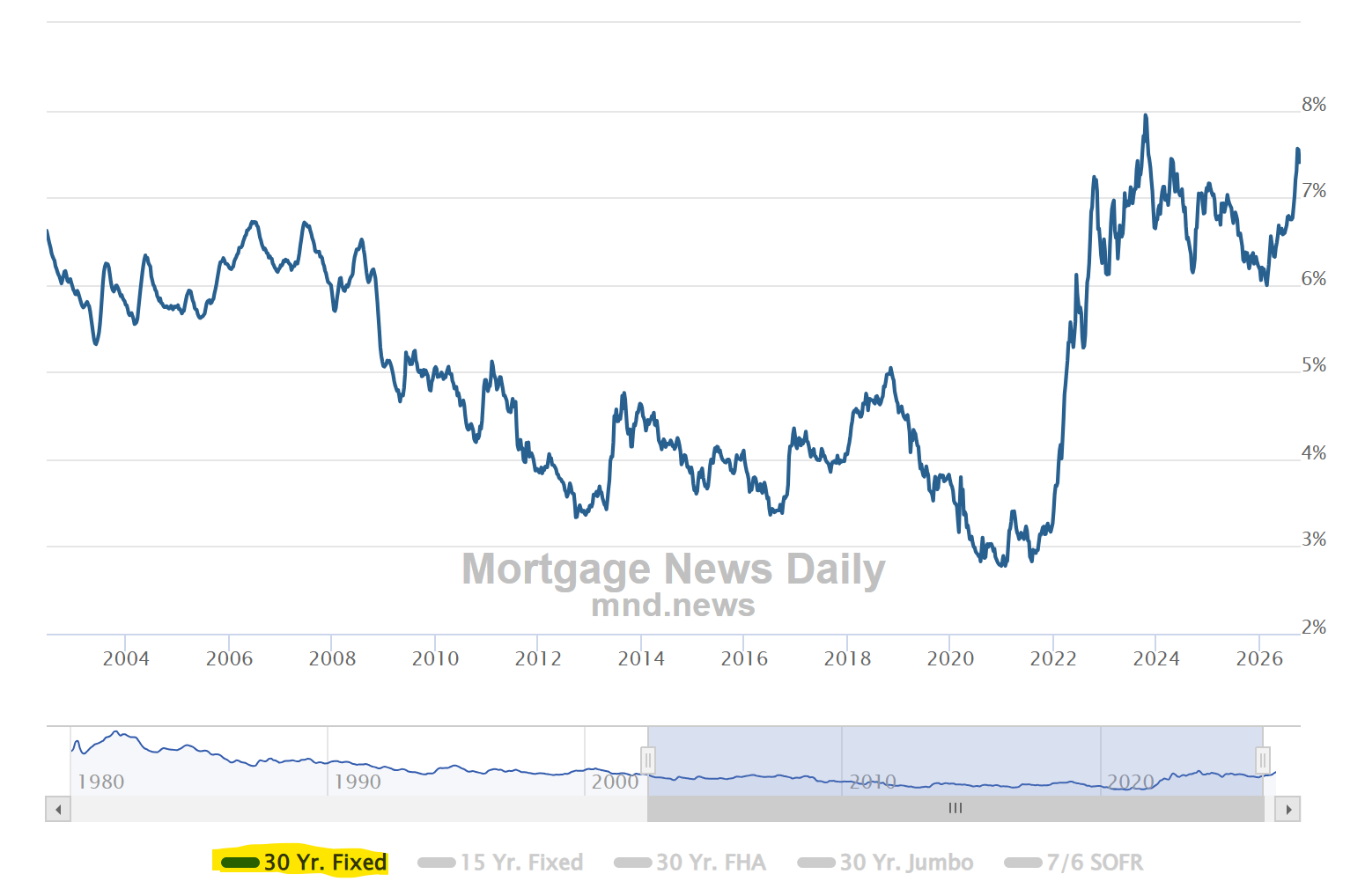
That’s a big affordability constraint, one I’ve noted in recent posts on interest rate movements—the 30-yr FRM moves with the 10-yr Treasury rate—but in this post, I want to update the quantities side of the equation.
For example, I was struck by yesterday’s housing starts release, nicely covered by Axios:
The number of housing units started by builders fell 5.2% last month, the Census Bureau said, to 1.22 million. It's down 7.4% year over year and near post-pandemic lows.
Starts of single-family homes fell 4.6% to their lowest level since March 2023.
Pending home sales fell 7.3% last month, the National Association of Realtors said Tuesday morning, to the lowest since the data was tracked going back to 2001.
Homebuilder sentiment fell this month to its lowest level since 2012, the National Association of Home Builders said Monday.
Here’s one long-term picture of the problem. It shows housing construction completions (single and multi-units combined) since the late 1960s, adjusted for population growth. With one exception before now—the 1980s, when the loss of a building tax break, a multi-unit glut, and the savings-and-loan crisis dinged the industry—it’s a highly cyclical series, meaning it goes up in good times and down in bad.
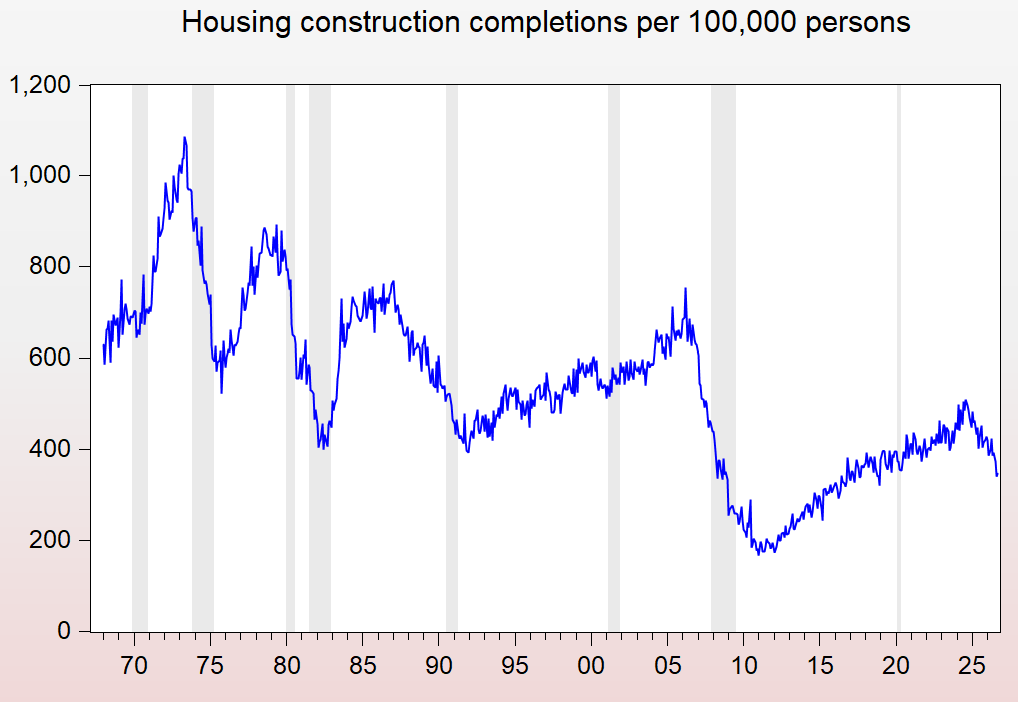
Except in the last few years, when completions have been coming down steeply, even as the overall economy and financial markets have been strong. It’s also the case that the level of completions remains below its long-term average, having never fully recovered from the bursting of the housing bubble in the late 2000s.
Those who follow my vibes work—the gap between macro outcomes and micro sentiment—will recognize that pattern at the end of the series above, as it tracks the tanking in econ sentiment and confidence series. That’s not a coincidence: the lack of housing affordability is a major factor in many people’s negativity about the current economy.
In other words, homebuilding has a structural, long-term problem on top of the more recent problem, which relates to financing and labor costs. Inflationary Trumpian policies are clearly implicated. The impact of tariffs and the war are juicing inflation, forcing the Fed to be more hawkish (raising the short-term rate they control), which has an outsized impact on the highly rate-sensitive sector.
Meanwhile, deportations are juicing labor costs in the sector:
“Nationwide, more than one-third of builders reported immigration enforcement activity in their market areas during the past month, causing construction delays and discouraging legal workers from reporting to work,” said NAHB chairman Bill Owens, an Ohio homebuilder, in the sentiment release.
In our recent housing-policy report from CAP, we pointed out that “According to one estimate, the Trump administration’s broad tariffs on materials such as lumber, gypsum, and steel, along with fixtures like kitchen cabinets and bathroom vanities, will add roughly $135 billion to the costs of residential construction over the next five years.”
Sticking with the near-term, the AI buildout is also in the mix here, as the spike in datacenter construction creates a lot more competition for employment and materials, while absorbing billions in available credit, thereby nudging up rates. Basically, that problem redounds to an interest-rate INsensitive sector (hyperscalers’ are brushing off higher rates) competing for resources with a much more rate-sensitive sector (homebuilding).
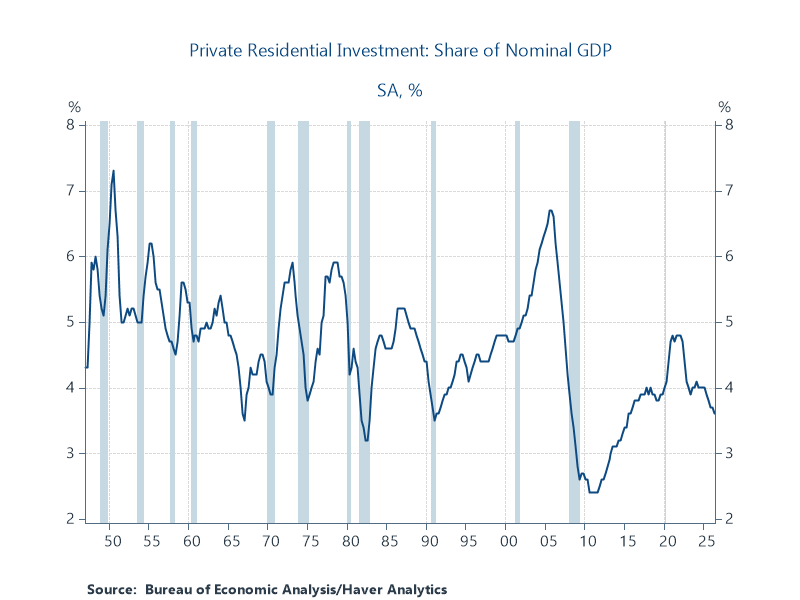
This is showing up the in GDP accounts. Historically, the residential-investment share of GDP has been around 5%. That share blew out in the housing bubble, before crashing to its lowest share on record. It was last seen at 3.6%, its lowest share in over a decade.
One other short-term observation, one that maps this statistical information onto politics. I recently read this New Yorker piece on the rise of the Democratic Socialists of America as a political force. One theme of the piece is that a consistent motivator for members joining the movement is frustration over how much of their income goes to rent. As one organizer put it in describing the movement’s recent growth: “There are renters everywhere.”
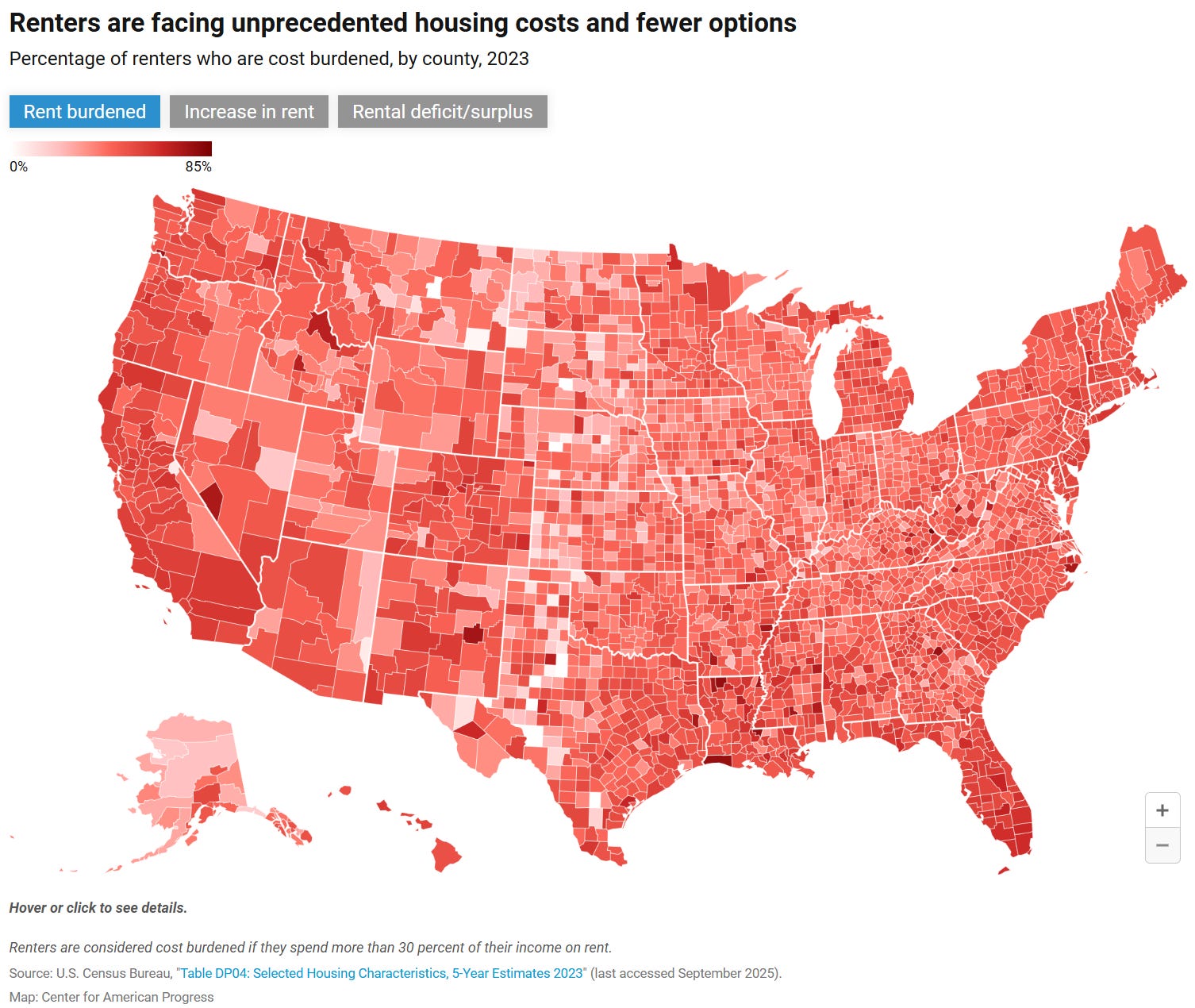
There’s solid evidence to support this rent stress. In our CAP report, we point out that “the rent-to-income ratio has reached its highest level since 1980,” implying more renters and “burdened” by the traditional metric of spending more than a third of their income on rent; in expensive cities, that share can easily jump to half. Here’s a heat map from the report:
The structural problem is somewhat nuanced, in that when policy is not recklessly making financing and building more expensive, we have a housing market that generally performs okay, but only for those with means, at least in parts of the country where people want to live, given their jobs’ base, amenities, and so on. Any developer will tell you that building affordable housing in such places doesn’t pencil out.
The recently passed ROAD Act could help at the margins, though as Jim Parrott and I explain here, that requires rebuilding capacity at the federal gov’t housing agency. But ROAD is mostly a permitting and regulatory play—it has few resources behind it.
What’s needed, then, is to:
—Stop doing dump sh— which makes supply expansion more expensive.
—Continue to loosen zoning restrictions and take down permitting barriers (these are largely local, but the CAP report features ideas to incent localities to do so, while providing quick rent relief).
—Expand affordable-building financing and construction through expanding subsidies, FHA loan limits, and permits to build a lot more modular/manufactured housing.
—Learn from local efforts, wherein some towns and cities are making real strides in this space. I’m a big fan, e.g., of the Montgomery County, MD program wherein a local public development authority leverages a revolving loan fund that provides below-market rate financing for multi-unit projects. If the feds could get into that game, helping to capitalize the initial funds, I’m confident this model could productively expand.
For now, however, as Axios put it: “Builders can’t afford to build, buyers can’t afford to buy, and even the people sitting pretty with pre-2022 mortgages can’t afford to move.” That is a) not sustainable, and b) ROAD Act aside, a function of national governance that has been unwilling to focus on lasting solutions to this cyclical and structural problem.
If only there were an election coming up wherein this dysfunctional status-quo was on the ballot!
Housing completions per person is a meaningless number because the relevant number is housing occupancy. A 6 bedroom, 5 bath house, like mine, with one person living in it is completely different from a 1 bedrrom 600 sq/ft apartment. In terms of real economics we chose to build much larger housing per person over the past century. We have a huge amount of unused housing space, bedrooms and bathrooms, filling the suburbs of many US cities. Here in Colorado we have had a large post-pandemic building boom in the mountains for recreation properties which are unused much of the year. Probably every person temporarily renting the new housing in the mountains has housing elsewhere. We built more housing but it doesn't house more people on net.
Somewhere in this 'can't afford to move out' phenomenon it seems like there's an important block on worker's being able to afford to live in reasonable proximity to where they work. I'm having a hard time articulating the point, but a lot of boomers are aging in the house they moved into early in their careers and where they raised their kids. After they left the labor force, there were job vacancies that got filled, or would be filled if workers were available. But if the boomers won't move on at a price workers can afford, where are we?