

Right now, literally everyone I know is on shpilkes (Yiddish for “pins and needles”) ahead of the mids tomorrow. I plan to scribble a bit here, clean my closet, exercise, get my oil changed—anything to get from time t to time t+1 or t+[whenever the votes are counted].
I gave my “formal” closing argument a few days ago, so I won’t revisit it here. It’s been gratifying to see the media elevating these themes:
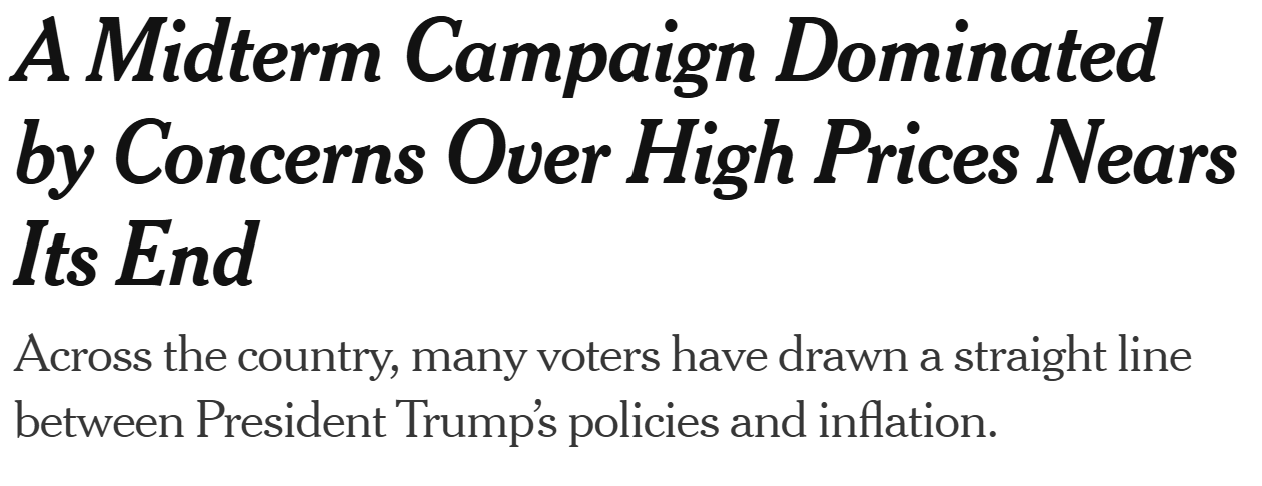


The last one, from the WSJ, emphasizes a theme of this ‘Stack: overall growth has been solid, driven by consumers spending and AI-linked investment, though I’ve argued that these are both fragile. Real wages for most workers are down recently on the back of war-induced inflation, which poses a constraint on spending. Otoh, folks can and are spending out of savings, which can only persist for so long and reduces a potential buffer if conditions soften. For wealthier households, asset-appreciation drives wealth-effect spending (assets rise $1, leading spending to rise $0.02’ish). But we’re already seeing nervousness creeping into the AI trade in ways consistent with Ryan and my (and many others, e.g., Dean B) bubble hypothesis.
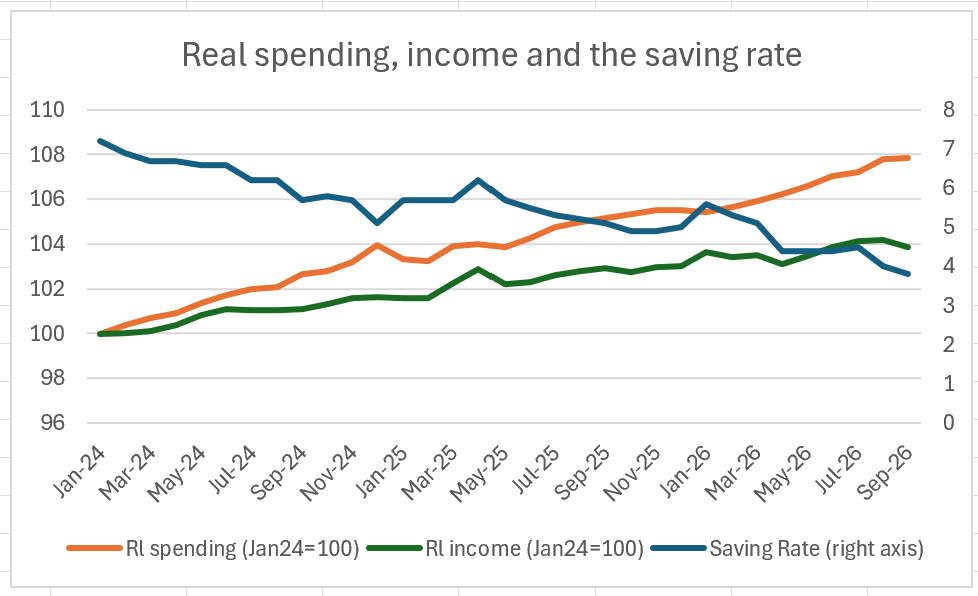
Here’s a telling figure in that regard: real spending’s been outpacing income growth for the last few years, while lower savings have been making up some of the difference. Squint at the end of the series and you see that real income has been flat in recent months. And these are aggregates; one can assume a degree of K-shaped dynamics in there somewhere.
Finally, a quick look at some of the evidence of voter dyspepsia, through three econ sentiment/confidence series. The figure is admittedly a bit hairy, so let me explain.
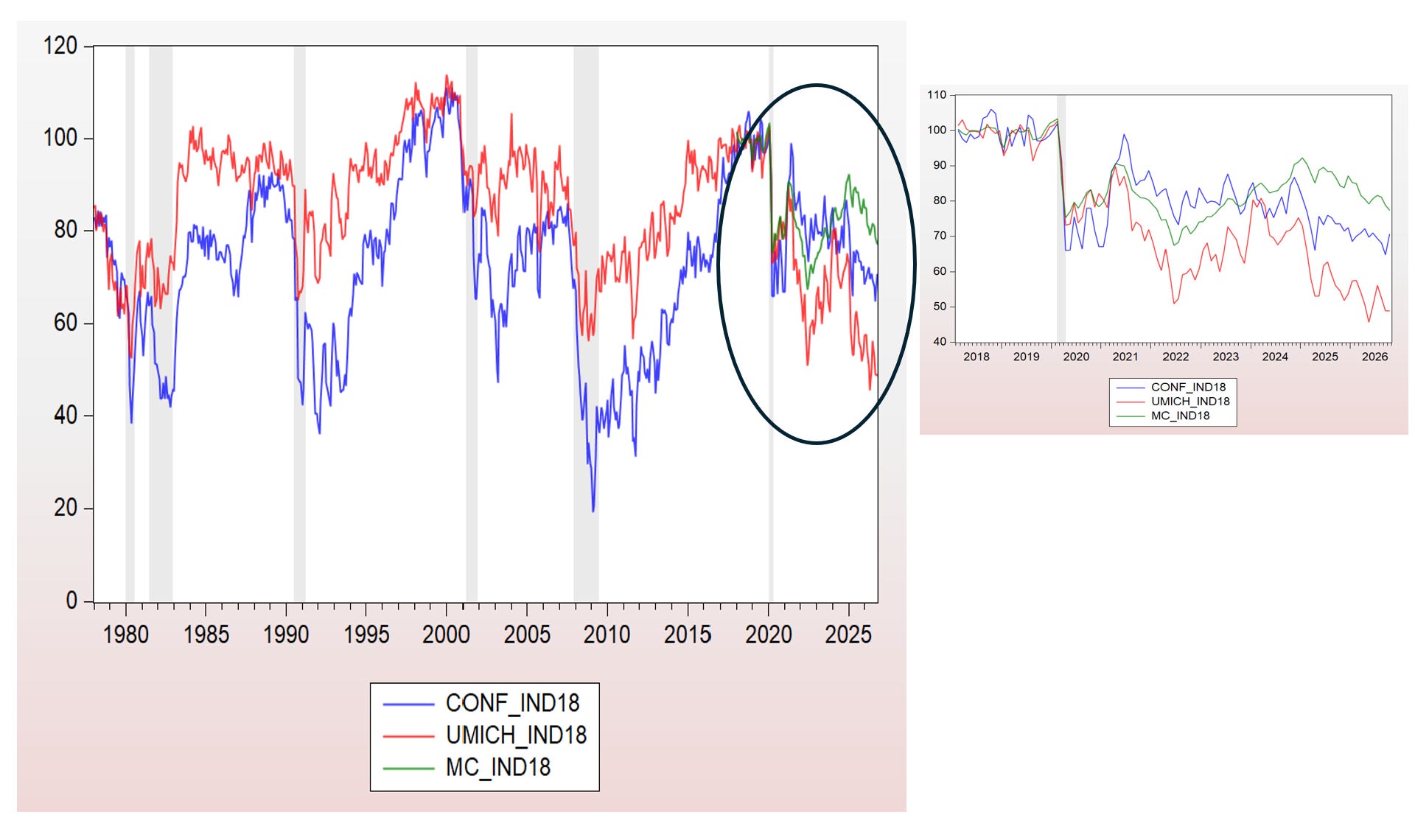
It plots three indicators, all indexed to 2018=100:
—the Conference Board Consumer Confidence Index
—the UMich Economic Sentiment Index
—the Morning Consult (MC) Sentiment Index, which only exists since 2018.
The latter is probably the least familiar, but you can think of it as UMich purged of the recent downward bias that is believed to have entered that index in the past few years. A few observations:
—The vibes gap is unequivocally clear at the end and in the pullout that zooms in on recent years. In most other business cycles, you get the predictable cyclical pattern, in which case, we might well be having a quite different electoral discussion. But not so in this expansion.
—UMich and MC were moving up starting the second half of ‘22, but when Trumpian inflationary policy took hold, they reversed course and headed south. That’s a strong signal that something changed. FTR, I give more weight to the shallower decline of MC vs. UMich, but the direction of travel is clear.
—The Conference Board measure is both more cyclical overall and pretty linear in the recent period. The reason is likely that this measure is known more to reflect people’s vibes about the labor market, whereas UMich (and MC) are more sensitive to prices. Here are the relevant correlations between the two indices and the unemployment and yearly inflation rates, based on pre-pandemic data:
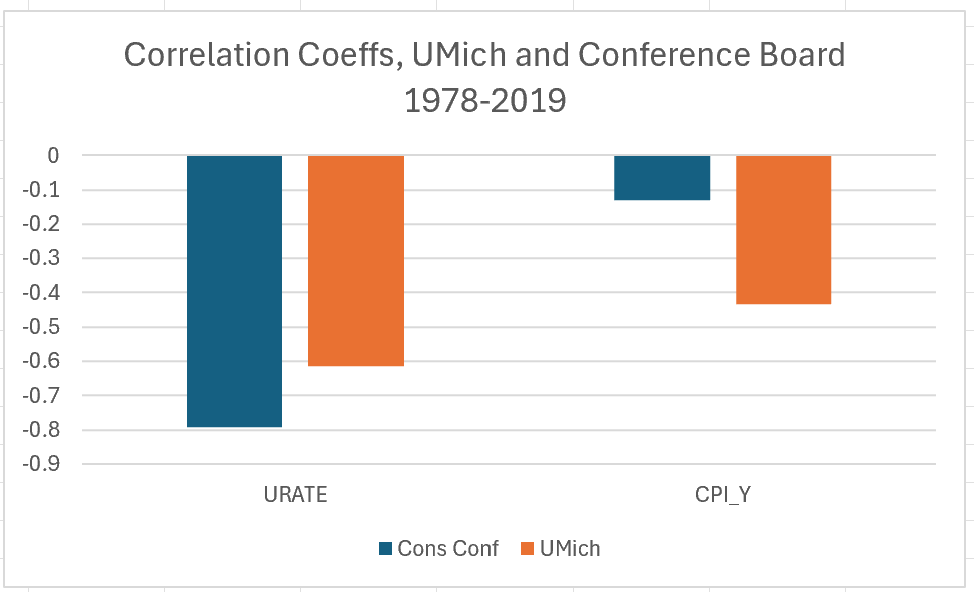
On unemployment, both carry fairly hefty negative correlations, with the Conf Board’s about 20bps larger. But on inflation, you see a larger difference, with Conf Board hardly correlated at all; and that’s before the pandemic-induced inflation took off.
I’m sure I’ll be compelled to post once we see how the vote is turning out, and be sure to tune in tomorrow to our election day version of Let’s Do Lunch on the Contrarian website, where I’ll be hosting Skanda Amarnath from Employ America and the Kitchen Table Project. We’ll get into some of KTP’s (and CAP’s) affordability-agenda items, ones I expect and hope will become more relevant in a matter of hours!
Two years ago, I had the insight while walking the dog that the country was going to reelect the Moron. Yesterday, I noticed something new in my "leans Republican" corner of northern Fairfield County, CT -- someone had ripped up a neighbors sign promoting a Democrat. The cult is scared because they know their number is up.
It is disappointing that temporary economic factors are such a primary influence on voter's preferences. There are many more fundamental issues that should be motivating voters. One often neglected issue is the quality of our representatives.
I think voters would be well served to understand that the job of a legislator is, or should be, the hardest job possible. While we expect that a doctor will be well-versed in medicine but not necessarily economics, or that a chemist should understand chemistry but not foreign affairs, a legislator is expected to "right" about any and every issue that faces our society. Members of Congress address issues as wide-ranging as nuclear policy, fire resistant sleepwear, abortion, weights and measures, and federal fiscal policy.
We should be electing the best, smartest, clearest thinking people, not just those who agree with us on some hot topic of the day.