


[JB: This post is joint with Ron Bloom, who co-led the Presidential Task Force on the Auto Industry back in the Obama days—I was a member. Ron’s career has included this and other senior leadership roles in business, labor and the Federal Government.]
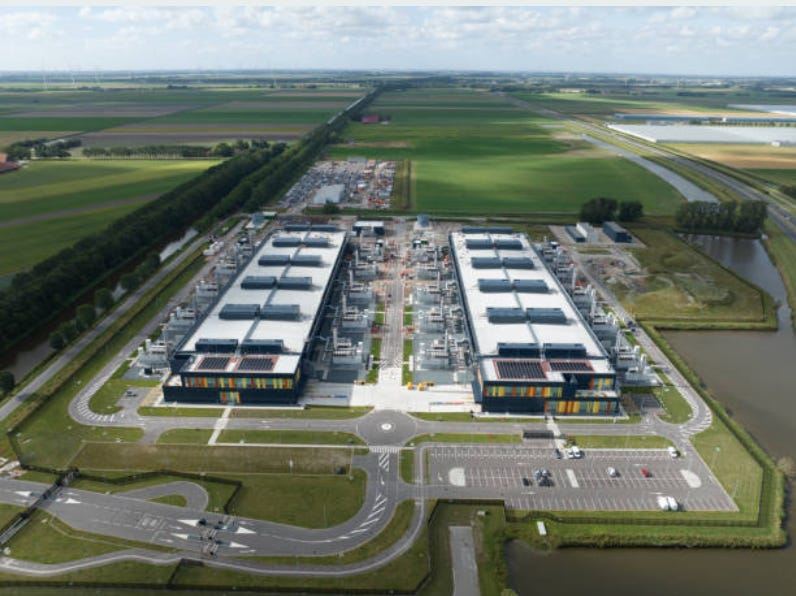
In an election season brimming with partisan rancor, a rare bipartisan, grassroots consensus has emerged: over two-thirds of Americans now oppose new data centers going up in their communities, and that share is rising. Opposition is high across the political spectrum and includes rural, urban, and suburban voters. Local moratoria are spreading from New York to Virginia, Georgia, and even Texas.
Two groups stand out on the pro-data-center side: a shrinking band of AI accelerationists and the workers building the data centers. Regarding the latter, the Wall Street Journal reports that “Unions and construction trade groups are now entering the fray from the other side, warning that such actions endanger thousands of building-related jobs. They are threatening to withhold support of candidates opposing the data-center projects.”
The public is right that a pause is warranted. But from the “crisis-as-opportunity” file, the pause offers a chance to lock in a durable set of agreements — between those building, backing, and financing the data centers, the unions representing the workers most qualified to build them, and the communities hosting these facilities. Such agreements will help determine whether AI grows as a productive, positive American industry or becomes mired in a destructive conflict that will leave all sides, and our nation as a whole, worse off.1
We should start by recognizing what this debate is really about. While there are legitimate concerns about the impact of data centers on the communities in which they reside, the opposition is also a proxy for the fight over AI itself — about the concentration of power, the fear of job loss, and an economy that feels like it’s being run for the benefit of a handful of tech billionaires who assure us their invention will dis-employ us, wipe us out, or both. Gallup reports that only 20% of Americans express confidence in major technology companies, the lowest level the firm has recorded.
Therefore, a deal on data centers needs to be part of a broader understanding that includes comprehensive rules on AI safety, measures that tilt the odds toward augmenting work rather than displacing it, meaningful protections for workers affected by AI, reliable mechanisms for broadly sharing the economic gains, and a clear-eyed strategy for competing with China. Deployed with such guardrails, AI has the potential to meaningfully lift US productivity, which remains the only durable route to higher living standards. But that potential is realized only if productivity growth ceases to be a spectator sport. Workers must have the leverage to claim their fair share.
Focusing on data centers, we start with a simple equation. The industry wants compute. The people want fairness, safety, jobs, and freedom from negative spillovers. Presto: the making of a deal.
We envision a deal in three parts: Project Labor Agreements, Community Benefits Agreements, and a longer-term effort to on-shore the production of the equipment and materials needed to build the data centers.
A Project Labor Agreement (PLA) is a pre-hire collective bargaining agreement that sets wages, benefits, and work rules for a construction project before construction begins and requires every contractor on the job to abide by it. For a data-center build, that means a guaranteed pipeline of trained electricians, pipefitters, and other skilled trades; a no-strike, no-lockout commitment that keeps a multi-billion-dollar project with dozens of contractors on schedule; and safety and training standards that are particularly important on sites with this much high-voltage electrical and cooling infrastructure.
PLAs are good for AI firms because they de-risk the single biggest threat to projects of this magnitude — a labor dispute or a skills shortage that delays a facility burning hundreds of millions of dollars a year in financing costs while it sits unfinished. They are good for workers because they guarantee area-standard wages and benefits and a genuine apprenticeship pipeline into a growing trade.
Second, the deal requires real, enforceable Community Benefits Agreements — not the box-checking kind, but ones that guarantee that sponsors internalize rather than impose their costs on local communities. Such agreements should include reduced electric and water rates for the surrounding community, funding for the local infrastructure upgrades (roads, substations, water systems) these facilities require anyway, and substantial investment in the schools, parks, and public goods that make a host community better off for having said yes. Local hiring commitments should be table stakes. And “enforceable” must mean something concrete: binding terms with real penalties for non-compliance and an independent local body to monitor them, not a voluntary pledge a sponsor can quietly let lapse once the ribbon is cut.
Third, our national data-center conversation needs to connect to a longer-term effort to source future buildouts with substantially more domestic content. For a typical facility, labor runs just under half of total construction cost, with purchased materials and equipment making up the remainder: structural steel and concrete for the shell; transformers, switchgear, and backup generators; UPS systems and battery storage; chillers, cooling towers, and piping for both air- and liquid-cooled halls; cable tray, wiring, and fiber; and fire-suppression and security systems.
Current domestic content varies sharply by category, but in many cases it is quite small — even cooling equipment labeled “Made in USA” typically carries 30–60% imported content, concentrated in specialized compressors. Lead times on high-capacity transformers and switchgear, for example, are now stretching to four years, in large part because domestic production of the electrical steel and copper they require is constrained.
We recognize that this shift will take much more time than our other ideas. Extrapolating from announced plans, we estimate that spending on purchased materials for the facilities themselves could easily exceed $1 trillion over the next ten years. Even a modest shift of that spending toward domestic manufacturers represents an industrial-policy opportunity measured in the hundreds of billions of dollars over the coming decade.
Chips and servers deserve their own mention because they account for the lion’s share (60%) of a data center’s total capital cost (that $1 trillion covers the facility, not the computers). Over the same decade, that implies perhaps $3 trillion in cumulative US spending on chips and servers through 2035. And because the United States imports well over 95% of the servers it deploys — with a single source, Taiwan, accounting for roughly $86 billion a year in the assembled data-processing equipment feeding this boom — the overwhelming majority of that $3 trillion is currently flowing overseas.
Onshoring such production requires extending CHIPS Act incentives beyond chip fabrication to the assembly, packaging, and testing steps that turn a finished chip into a server rack. Extending domestic-content incentives to that downstream assembly would capture ancillary benefits that go well beyond the data-center build: a broader base of skilled technician and engineering jobs, a shorter and more resilient supply chain for every industry that depends on advanced electronics, and stronger leverage in the broader technology competition with China.
A pause that gets these three parts right — a PLA that protects the workforce building these facilities, a Community Benefits Agreement that protects and benefits the people living near them, and a longer-term domestic-content commitment that rebuilds the industrial base supplying them — turns data centers from a veto point for AI in America into the foundation of a successful buildout of a vibrant new industry.
When two opposing sides each have something valuable to gain or to lose, there is an opportunity to turn a closed fist into an open hand. When it comes to data centers, now is a good time to take a breath and put in the work to ensure that American workers and their communities can benefit from this buildout. It’s the only fair way forward, and the one most likely to work.
Note from Jared: This data center discussion is consistent with the bubble evidence Ryan and I wrote about earlier this week. Bubble or no, there will be data centers, though overinvestment (relative to future profitability) may mean the hyperscalers are overbuilding. None of that precludes the necessity for the pause and the interventions we recommend herein.
This hits a lot of high notes, but unions will be impotent if there is no right to strike, and an alternative policy needs to address the environmental impacts. Burning huge amounts of natural gas to power data centres seems to be the norm.
I think you are missing an important item. What happens when the data centers aren't needed. If this boom pops, or the operating company goes bankrupt, or it becomes obsolete, ... any of which could happen quickly, the utilities are left with over capacity to maintain, mothball or ... all at our expense. Since there is so much money to be made by the AI companies, especailly as they go public, they should set aside enough of that (at the founder's price) stock for the community to sell and keep for these problems. Besides all AI has already mined our individual and communal knowledge without paying us for it, let's not keep giving money away!