


On Monday, Anthropic released their much-anticipated SEC security registration statement (“S-1”) ahead of their IPO next month, from which the firm is looking to receive between a $1.5-$2.0 trillion valuation. The document contained crucial information about Anthropic’s finances which have only been leaked in bits and pieces over the past several months.
The big takeaway that AI bulls are highlighting is the company’s impressive revenue and profit growth. As the figure below shows, revenue has climbed from a few hundred million to 12 billion in only 18 months, and perhaps even more impressively, the firm appears, as of ‘26Q2, to be making an operating profit versus the operating losses on which we previously focused.
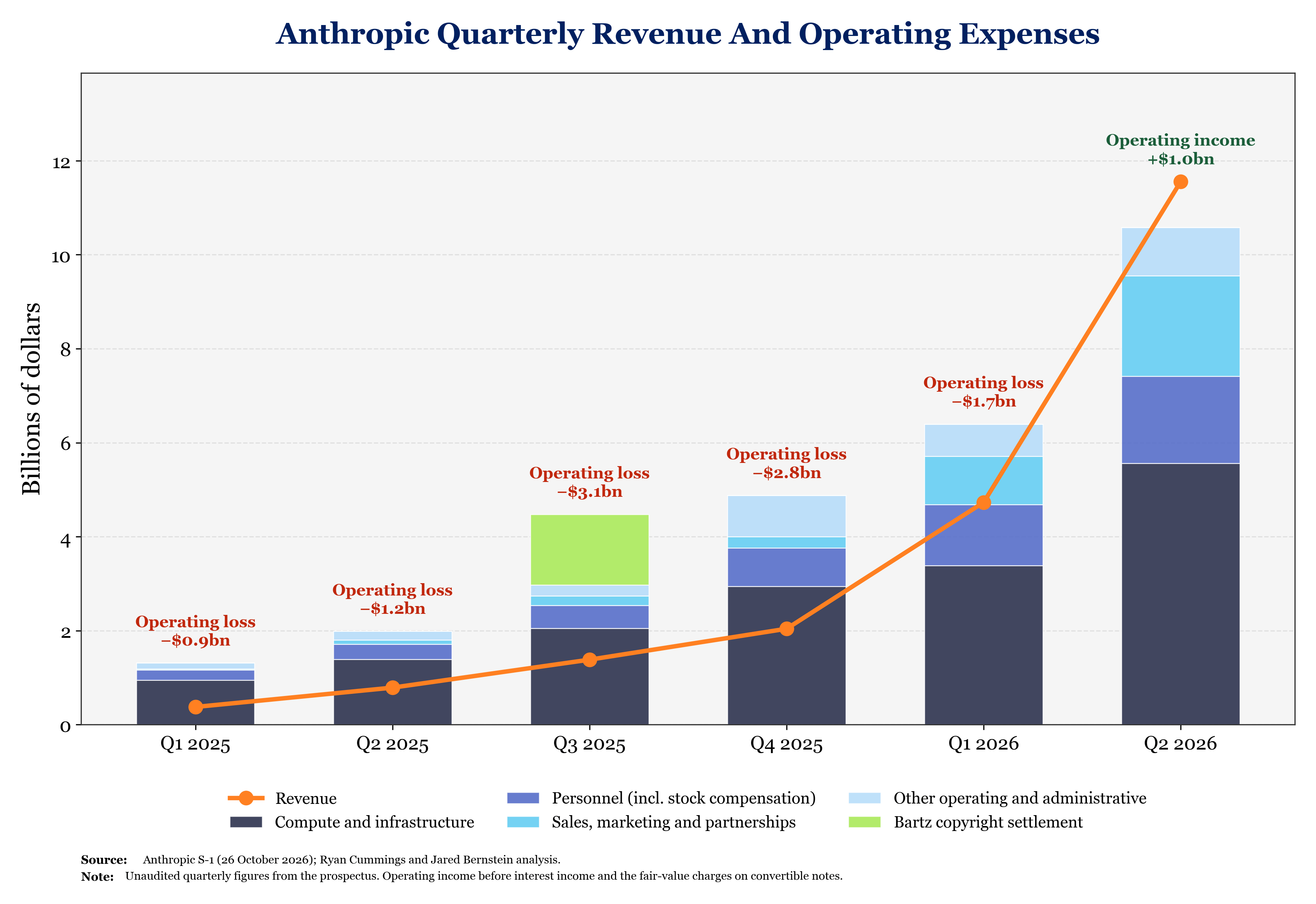
In various posts, we’ve argued that large gap between what AI firms are spending and what they’re earning looks awfully bubbly. If that’s right, at some point, investors’ patience runs out and they look for ROI elsewhere. Does Anthropic’s new info lead us to a rethink?
Nope. Beneath this explosive revenue growth, the S-1 also highlighted that it’s going to be a real challenge for the company to justify a $2 trillion valuation, in large part because of their future spending commitments. That is, Anthropic is committed to paying $795 billion for compute over the next ten years, of which $516 billion is broadly non-cancelable.
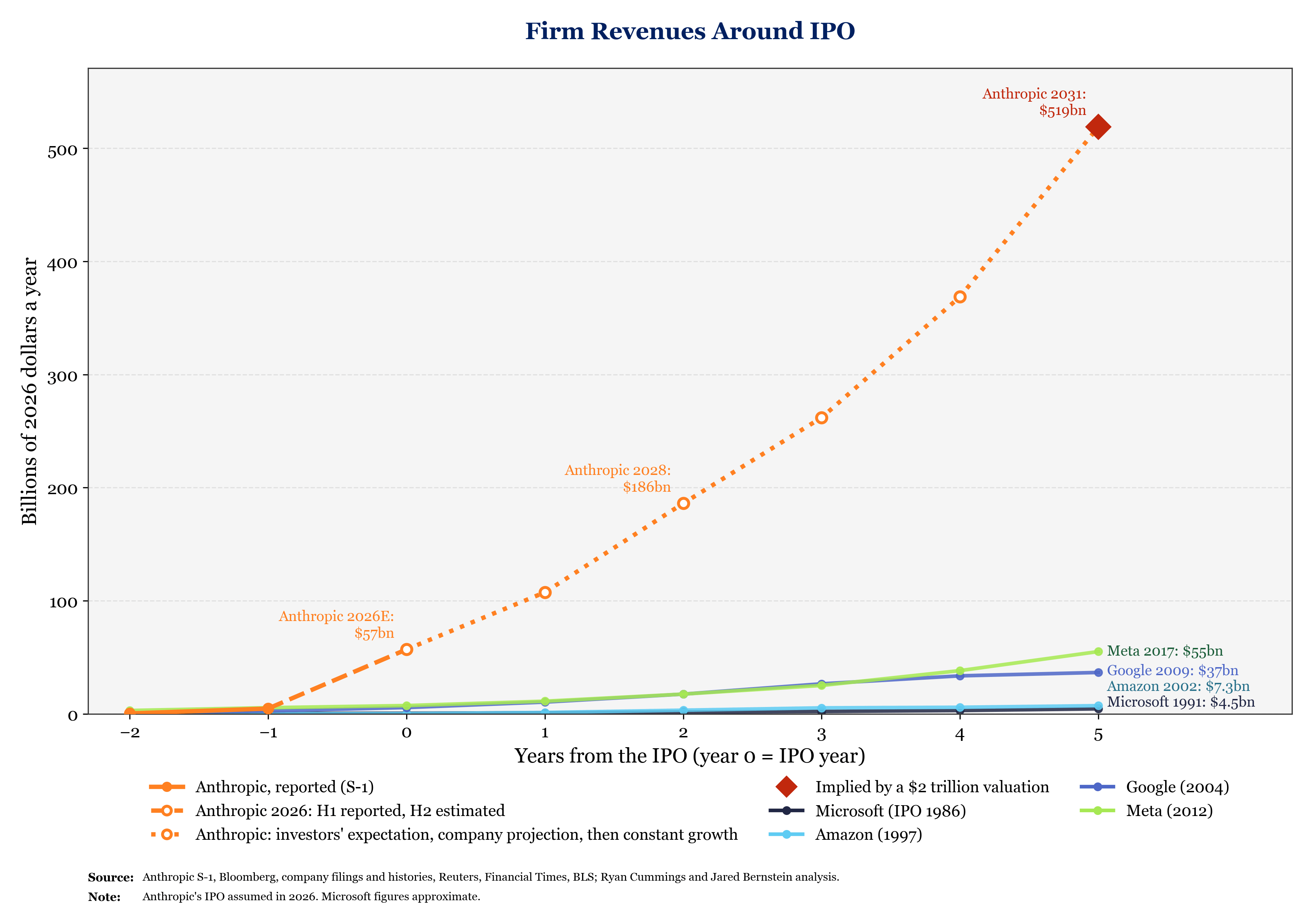
In order to offset these hefty expenses and keep a return that investors find acceptable, the company will need to generate revenue growth far beyond what they just announced. As the figure below shows, in order for the firm to justify their valuation and using a standard, conservative set of assumptions, Anthropic will need to generate $519 billion in annual revenue by the end of the next five years.[1] For comparison, we also show the revenue path of current tech giants from starting two years before they went public until five years after. Together, the figure implies that to meet investor expectations, Anthropic would need to reach annual revenue that’s more than14 times what Google generated after their first five years as a public company (adjusted for inflation).
When compared to the size of tech companies today, the amount of revenue that the firm would need to generate in 2031 would need to be more than double what Meta is currently making and $80 billion more than Google.
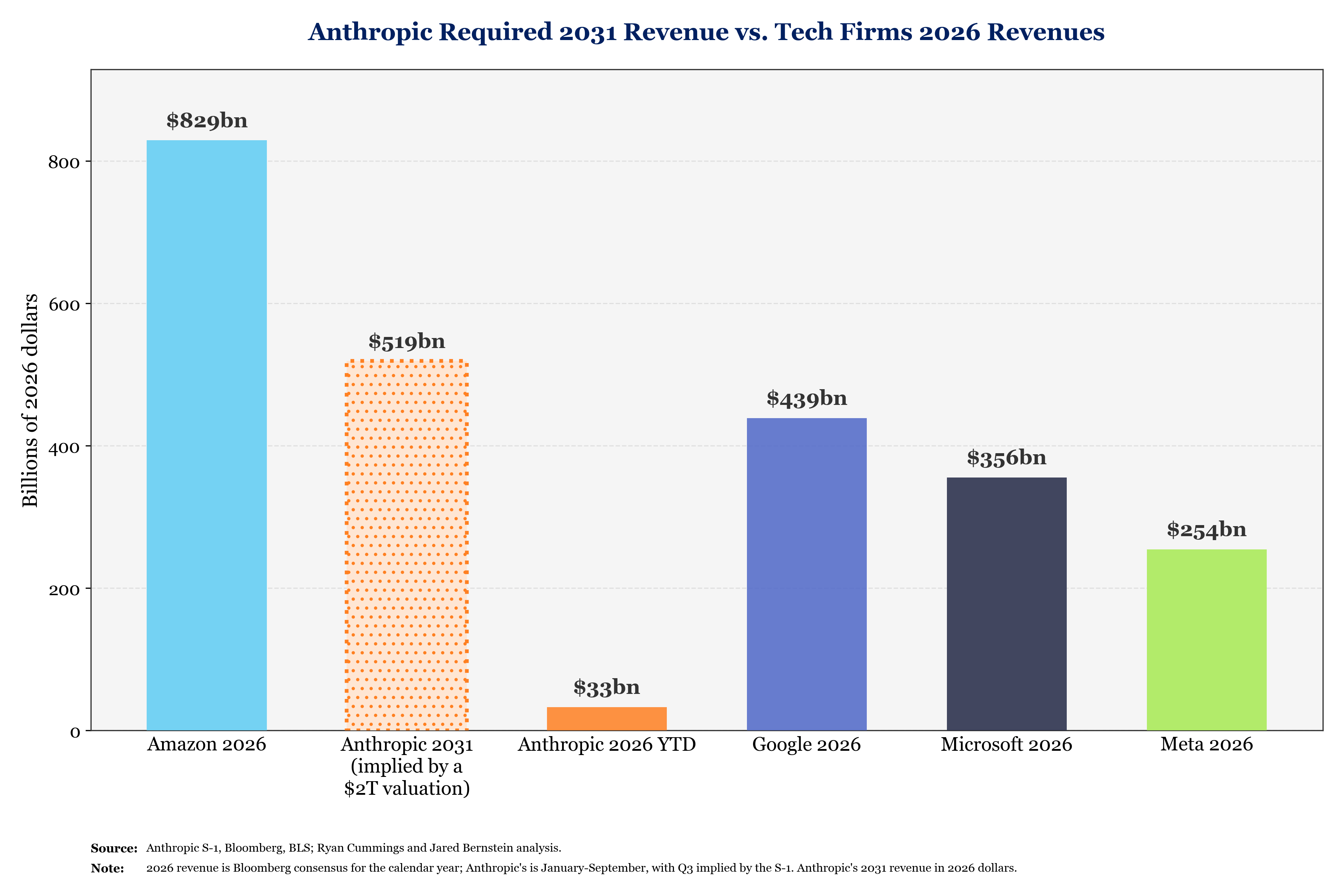
The natural next question is what happens if this—and all the other big promises made by AI boosters—don’t come to fruition? We’ll have more to say about that soon in an upcoming piece, but in this specific context, it would mean a lot of wealth would be wiped out. For example, if the company “only” generated $251 billion in revenue by 2031—half of what’s implied by their valuation, or roughly what Meta makes now—then the valuation would halve, wiping out $1 trillion worth of wealth from a single company.
Such a decline in the value is unlikely to occur in a single day, though; we view it more likely that after several quarters of missing the outsized revenue growth that the firm requires, markets will update their beliefs and the share price will adjust. When that happens, the science of bubble-ology leads us to expect such negative repricing to ripple through to other AI firms as well, because investors are not only examining the profitability of Anthropic specifically, but of the AI trade as a whole.
Right now, that trade is filled with a level of revenue optimism that we, and many others, find unrealistic. Of course, we could be wrong. Such analysis is by nature highly speculative. And none of these financial bubble concerns should detract from the potential transformational impacts of AI in the economy. But our guess is that there is a fair bit of pain between here and there.
[1] We assume a 10 percent annual return through 2031 to get future market value, and then calculate the earnings associated with a firm that size by dividing the market value in 2031 by the forward P/E ratio of the S&P 500 Technology sector (which is 21.3).. We assume a 21 percent tax rate and a 30 percent pre-tax operating margin (the median operating margin for the S&P 500 tech sector is 23.9 percent) for a net margin of 23.7 percent, which is then used to calculate the associated revenue.
Mr. Bernstein makes a persuasive case that Anthropic must grow explosively, judged both on its own terms and against the comparison set of other tech giants. But that comparison reveals a further difference worth noting: Anthropic has a singular technology offering. Every one of its peers is a portfolio.
Amazon stretches from cloud infrastructure to a package arriving at your door. Microsoft sells cloud services, but it also owns the operating system and the productivity software running on most of the world’s personal computers. Google is best understood as a conglomerate in its own right, with search, advertising, mobile, video, and cloud, each a business that could stand alone. Even Meta, which began as a single platform, is now a collection of services rather than the one product that founded it. For all of them, diversity is their strength. When one line stumbles, another carries the load.
Anthropic has no such cushion. Its technology is compelling, but the company is an all-in bet in a game where the others will remain standing, perhaps wobbling, if it should fall. They can absorb a failed bet. Anthropic cannot.
And if Anthropic should lose the bet, it opens the question of whether that causes the other cards in the house AI built to fall.
I’m an enthusiastic personal user of Claude. I have positive attitudes toward Anthropic. But I don’t see how they can protect themselves from competition that will undercut their revenue. I bounce back and forth among Claude, Gemini, and ChatGPT.