
The Media Really Doesn’t Know What To Do With Trump’s Lies
The Wall St. Journal steps into a steaming pile of Trumpian nonsense.

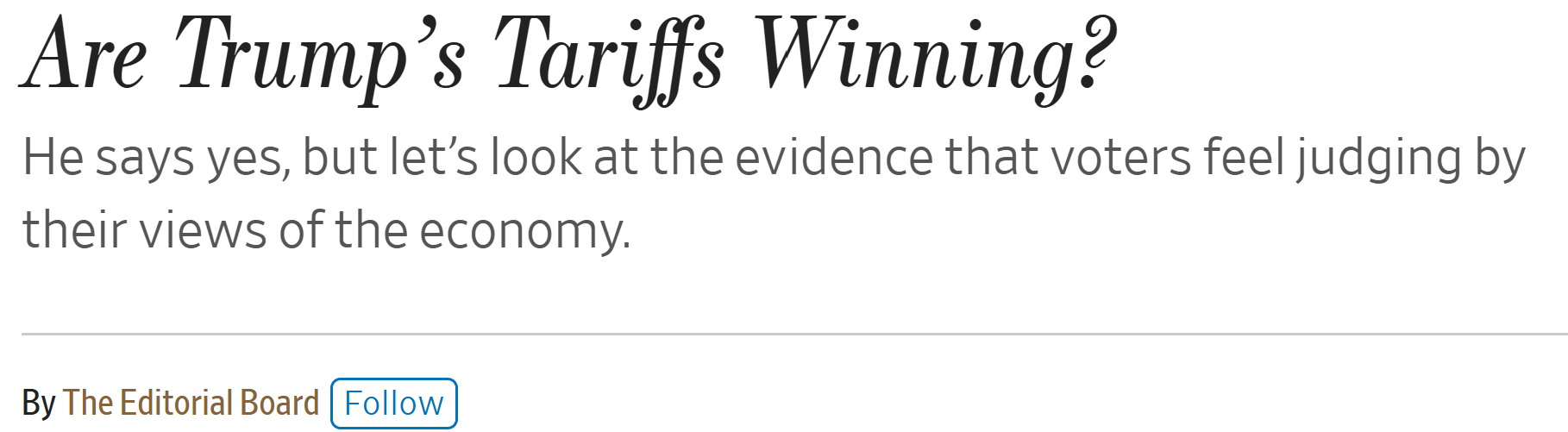
A few days ago the Wall St. Journal published an oped by President Trump wherein he argued how great the US economy is on his watch and why tariffs are the main reason for that greatness. It’s a steaming mess of an argument, a firehose of falsehoods, though the one upside is that I haven’t seen it referenced anywhere. It sunk like a stone under the weight of its lies.
I won’t go through them here (though I’m about to link to a strong rebuttal), as it would be a waste of both of our times. Also, as you’d expect, it’s a greatest hits album with all the golden oldies he constantly blathers on about: inflation is zero (vs. 2.7% in the last CPI reading), prices are down, foreigners have invested “$18 trillion!” in America (that would be 60% of GDP; biz investment is currently 14% of GDP). The irony is that, as I’ve often stressed in these pages, the macro economy is, in fact, quite solid, even if the job market has worrisomely softened. By far, the most potentially consequential macro development over the past few years is faster productivity growth. If that sticks—if we’re really, lastingly generating more output per hour of work—it means the US economy can grow faster without worrying about inflation picking up. Of course, there’s no guarantee that faster growth reaches working-class people in the form of higher wages, income, wealth; often, it has not. But those are all other discussions.
At any rate, I saw no reference to this hot mess until this AM, when a prominent newspaper ran a fulsome rebuttal to Trump’s claims. This new piece points out that solid research shows that, of course, tariffs have not been absorbed by exporters but passed through to American businesses and consumers, generating higher prices on those imports, hurting investment, and making production more, not less, expensive for our own manufactures, who have been aggressively shedding jobs (half of our imports are inputs into domestic production).
That prominent newspaper is the same Wall St. Journal that published Trump’s oped.
What should one make of this? How is one supposed to process the fact that the media publishes, without criticism or an accompanying fact check, a cascade of outright lies, only to rebut it a few days later? What does that say about our collective understanding of reality? And what should the WSJ have done in this case?
If you’re a newspaper with an oped page, and the President gives you an oped, you can argue that such a piece is de facto newsworthy. As the Journal themselves said in their rebuttal, “We thought we owed him the opportunity after our criticism of his tariffs.”
But unless his argument is fact-based and substantive, that’s ridiculous. The WSJ’s criticism of Trump’s tariffs has been wholly fact-driven—they’re consistently done great work on this, and I say that as someone whose ideology differs sharply from that of this ed board. If they say 2+2=4, nobody, not even the president, gets to pushback with 2+2=5.
I give them some credit for coming back with “no, it’s 4.” But that doesn’t fix what’s broken here.
I had a similar complaint about the NYT’s recent big-deal interview with Trump in the Oval. You can listen to the recording. They ask a question. He lies. They move on to the next question.
The only way to understand this is as performance art. It’s not a discussion about reality, facts, how policies play out in the real world. It’s a game, wherein Trump describes his alt reality and the media prints it because he’s the president and his reality matters. Which is true. It matters a lot and it’s one of the main reasons we’re in the mess we’re in. Never before has a president and his whole operation been so detached from reality, to the point wherein we see horrific things with our own eyes and they immediately say “no, that’s not what happened.”
But this is not benign, cute, or harmless. It’s not “oh, there he goes again! Whaddya gonna do? He’s the POTUS! You’ve got to run it.” It’s not just another flavor of our intense partisanship. It’s corrosive at best and fatal to democracy at worst. Allowing this false reality to fester has now been shown to be literally fatal to our fellow citizens.
I’m not a media expert, and I’m well aware that they’re in the business of selling news, and that clickbait = $ (though again, no one seemed to pick up on Trump’s oped). But there is no question in my mind that publishing falsehoods, even from the president—especially from the president—is not worth the money.
You may be thinking, “hey, it’s the oped page, not a column.” Well, I’ve written lots of opeds and in every case, the editors insist that facts be verified. I’m not the president, but there’s absolutely no reason that the same rules shouldn’t apply.
Yes, of course, they have to cover him. But not like this.
No, it really *doesn't* know how to deal with this, and though I'm an editor, writer, and erstwhile journalist (weekly newspaper division), I don't really get it either. I do suspect, though, that it has something to do with the conventional news media's conviction that there's a high, impermeable wall between "news" and "opinion." Related to this is the belief that "objectivity" is possible (or desirable) in any human endeavor. Experienced reporters are duty-bound to keep their "opinions" out of news stories, even though their opinions are better informed that those of the overwhelming majority of their readers (and probably of their editors as well). However, as a writer I know it's absolutely possible to write a story with exactly the same verifiable facts in half a dozen ways, each of which will give the reader a different impression of what "the truth" is.
As to why the WSJ published that godawful op-ed, maybe because they thought their readers would see through it? maybe because they were afraid of being sued? maybe because anything the president says/writes deserves to be heard/read? I mostly agree with the latter: we *need* to know what the U.S. president is writing, or at least putting out under his name. But we also need journalists and other commentators to critique it and put it in context. And that's not what's happening in the so-called "legacy media" these days.
Once again, your analysis is spot on