

Prologue: I suspect I’m not the only one dealing with the cognitive and even spiritual dissonance of talking about things as if we’re in normal times, which we decidedly are not. I’m talking about the murder of Renee Nicole Good in Minneapolis by a masked agent of the state, the illegal invasion of a sovereign country, and perhaps even scarier because of what it portends about the future, the refusal by policymakers or the legal system to hold the administration or its ICE henchmen responsible for these actions. I don’t know if you listened to that new NYT interview with the president that’s getting a lot of attention, but I had to shut it off after 10 minutes. I’m not throwing shade at the journalists; I suppose if the president is willing to talk to you, you take the interview. But if you listen to it with the mindset I’ve just described, it quickly, for me at least, reduces to normalizing the horrific actions just described and allowing Trump to spout lie after lie with virtually no pushback.
I’m still going to wrap up the political-economy developments of the week. I don’t see how not doing so helps the situation. But I wanted to be sure to provide some context for what follows.
The Job Market: Is It Good, Bad, or What?
Yesterday’s job report led to more confusion than usual. Most of the headlines correctly focused on how much hiring has slowed over the year (see first figure), and how this has made it tougher for incoming labor-market participants to find work (see second figure, showing the increase in jobless-spell durations).
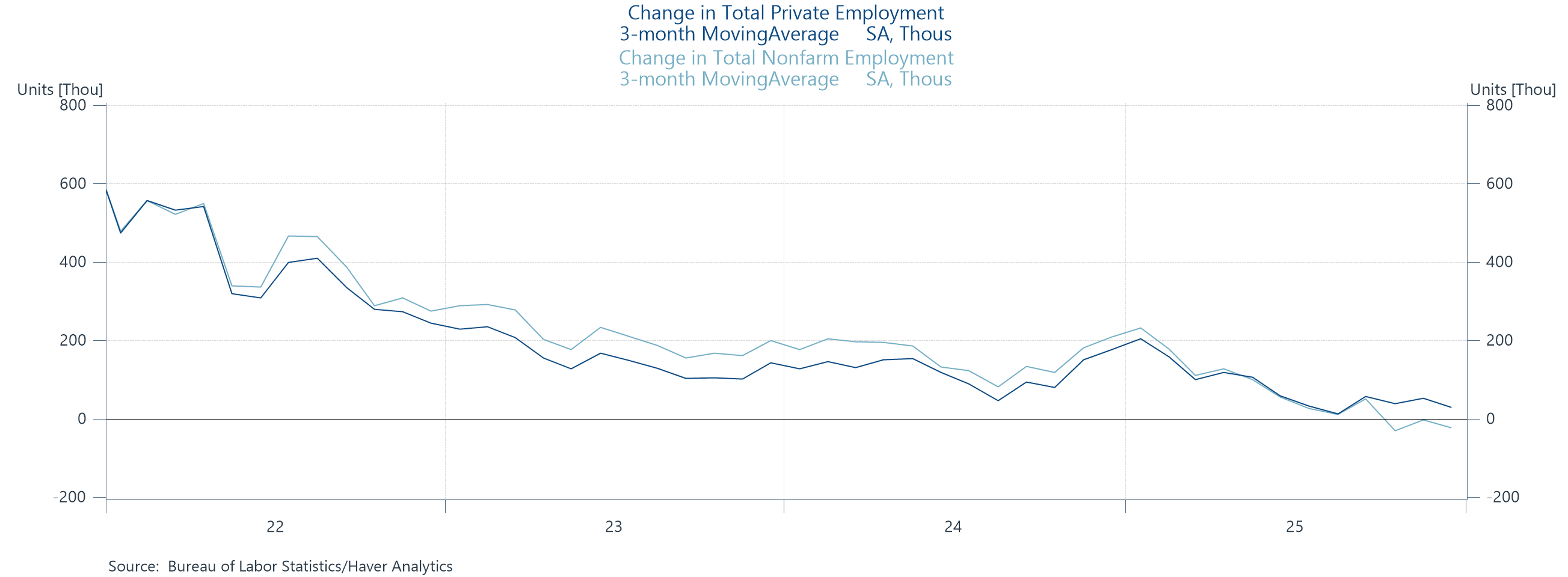
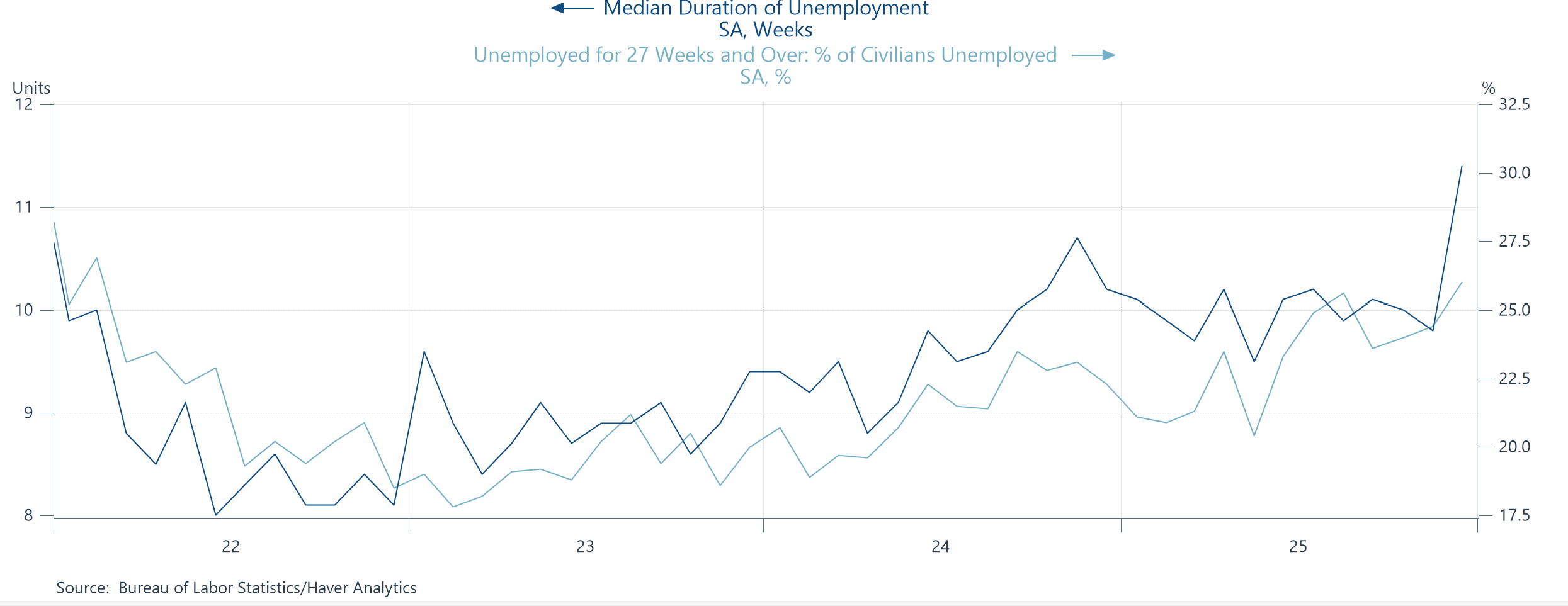
And yet, the unemployment rate ticked down to 4.4%. In past periods with such low hiring conditions, it has been twice that rate. That correlation is clear in the next figure, showing the actual jobless rate in blue and the simulated rate (red? green?) from a simple model using the hiring rate to predict the unemployment rate.1 That’s about a 4-point gap at the end of the figure.
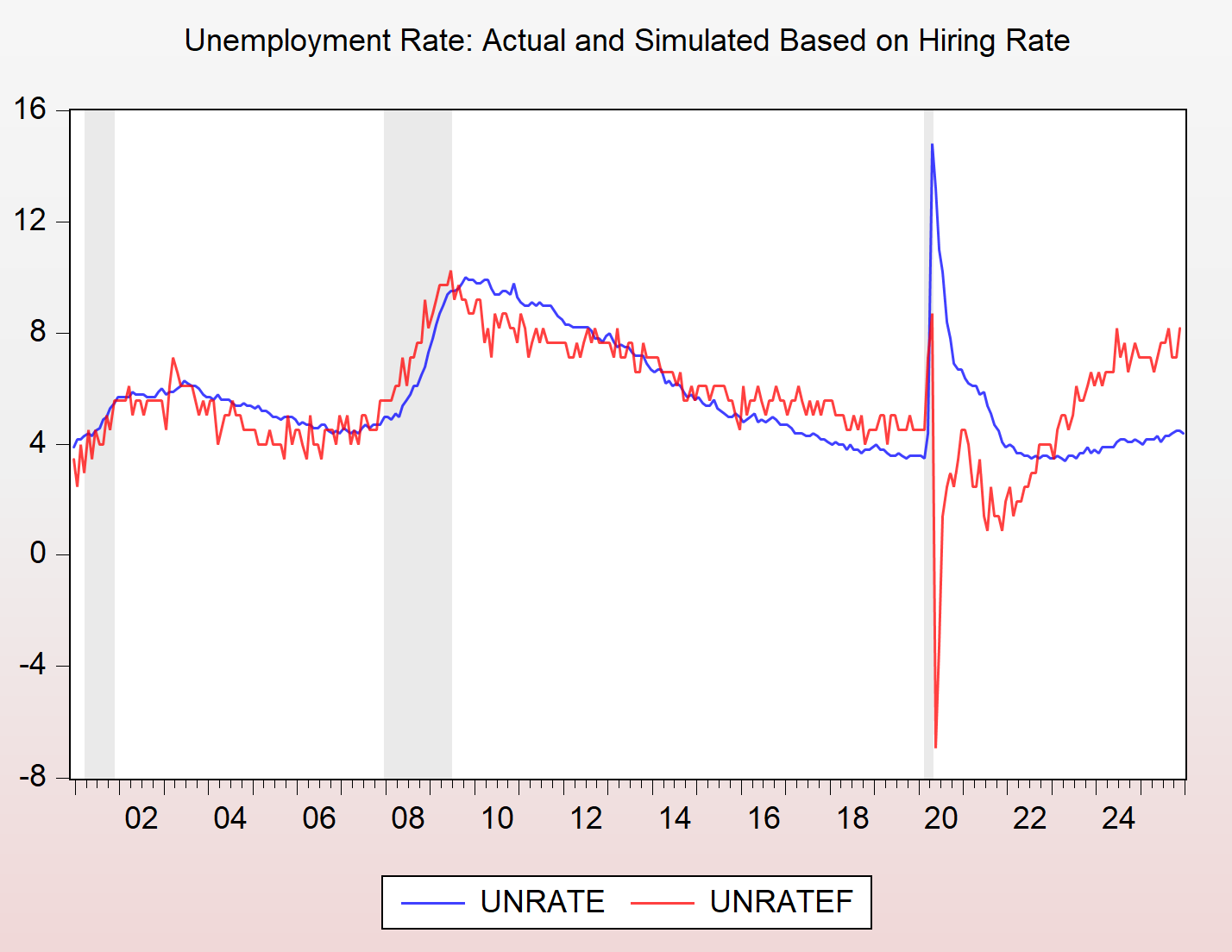
A big part of the difference is the smaller labor force. Finding a job is a tough game of musical chairs right now, for sure, as there are fewer chairs. But there are also fewer players.
So, bottom line 1, this job market is stuck in a fragile equilibrium. There’s too little churn, too little job creation, too few opportunities for players on the sideline to join the game.
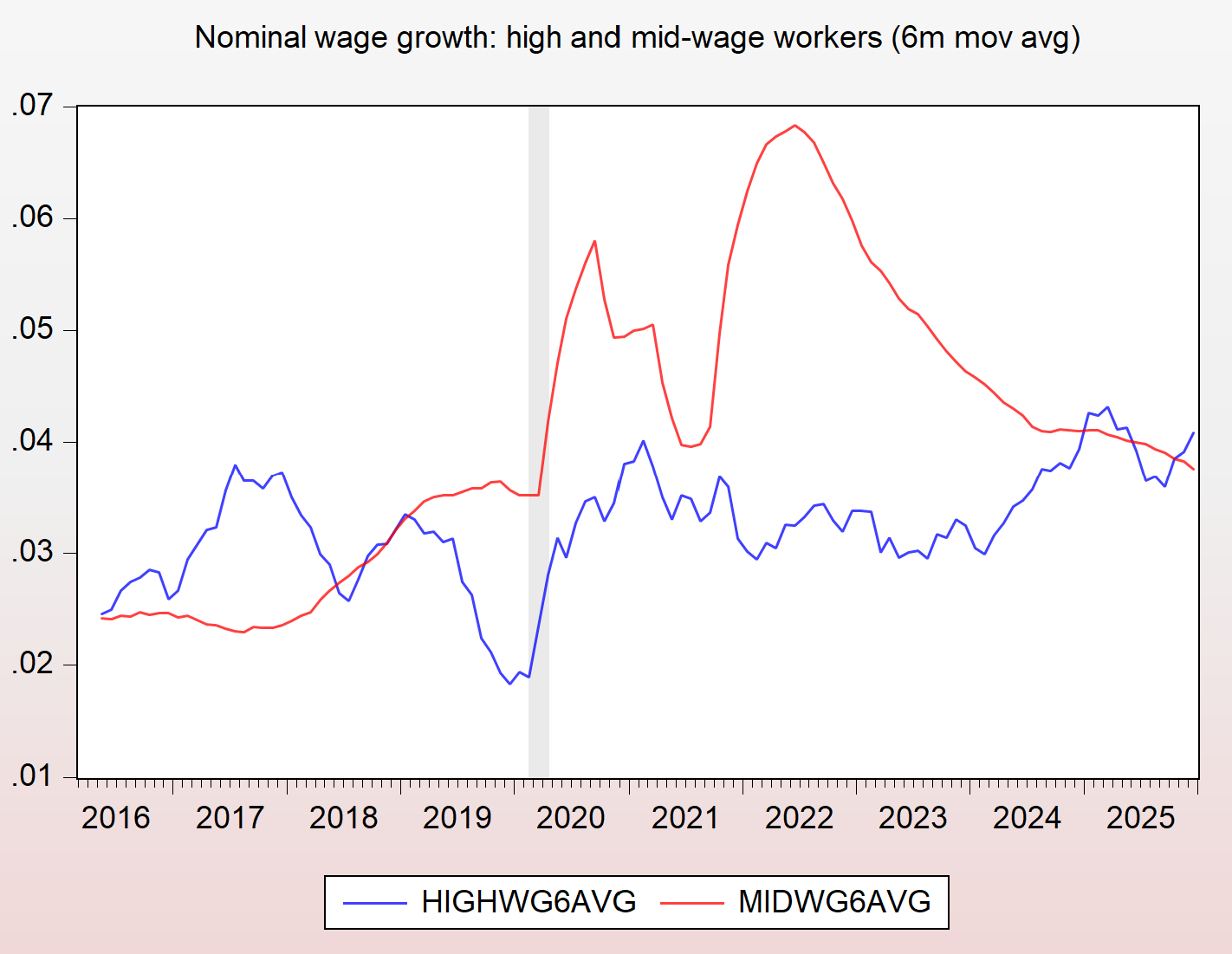
But bottom line 2 is that for those who have a job, which includes 95.6% of the labor force, wages are still doing pretty well. They’ve slowed, for sure, but to a growth rate that’s well above inflation—3.8% last year, while CPI inflation is running just below 3%. True, they’ve slowed more for low- and middle-wage workers than for high wage, a clear corollary of softening labor demand. Here’s nominal growth for low/mid vs. higher wage workers (using the same tricks I employed here).
The question going forward is thus how stable is this weak-hire but pretty-good-if-you’re-not-seeking-work job market. The modal forecast is that these conditions persist through the year, and, especially given good overall growth momentum driven by solid aggregate spending and AI-driven investment, that’s a reasonable outlook. But even if the game has fewer players, should we start to lose more chairs—i.e., should layoffs start to spike—there’s no job-creation buffer to stave off a downturn.
BTW, another thing that happened with this jobs report: Trump released some of the numbers the night before. His CEA gets the numbers on the Thursday afternoon before the public release and they usually brief the POTUS, who is required not to leak them. But as Trump plainly said: “They gave me some numbers. When people give me things, I post them.” There’s a simple solution for that.
Trump’s Team Is Missing the Point on Housing
I’m glad to see the admin recognize that the affordable housing shortage isn’t a hoax, but so far, they’re missing the boat. There’s no solution to the affordable housing crunch that doesn’t add new supply, yet thus far, their efforts have largely missed that target.
They started with the patently awful 50-year mortgage idea, which probably wouldn’t even lower costs (as lenders would want higher returns for locking up their $’s for longer periods), and would definitionally reduce the accumulation of home equity.
Next, they said they’d ban institutional investors from taking homes off the for-sale market to put them on the rental market. It doesn’t appear they can do this without Congress, but the real problem is that this just shuffles supply, it doesn’t add to it; it may lower home prices but it raises rents (fewer rental properties). Also, when it comes to the big investors, we’re talking a tiny share of the housing stock, as I explained here.
But it’s the latest from last week that I find both most interesting and most threatening, though less to affordability than to the broader economy. I’m talking about Trump’s instructions to the GSEs—Fannie and Freddie—to purchase $200 billion in existing mortgage-backed securities (i.e., not to create new MBS as they often do, buying and packaging home loans, but to buy existing MBS on the market).
The expectation was that Trump’s plan—which he has the authority to authorize—could lower the mortgage rate by perhaps around a quarter point. Increased demand for MBS raises their price and lowers their yields, some part of which gets passed through to homebuyers in lower mortgage rates. And lo and behold!:
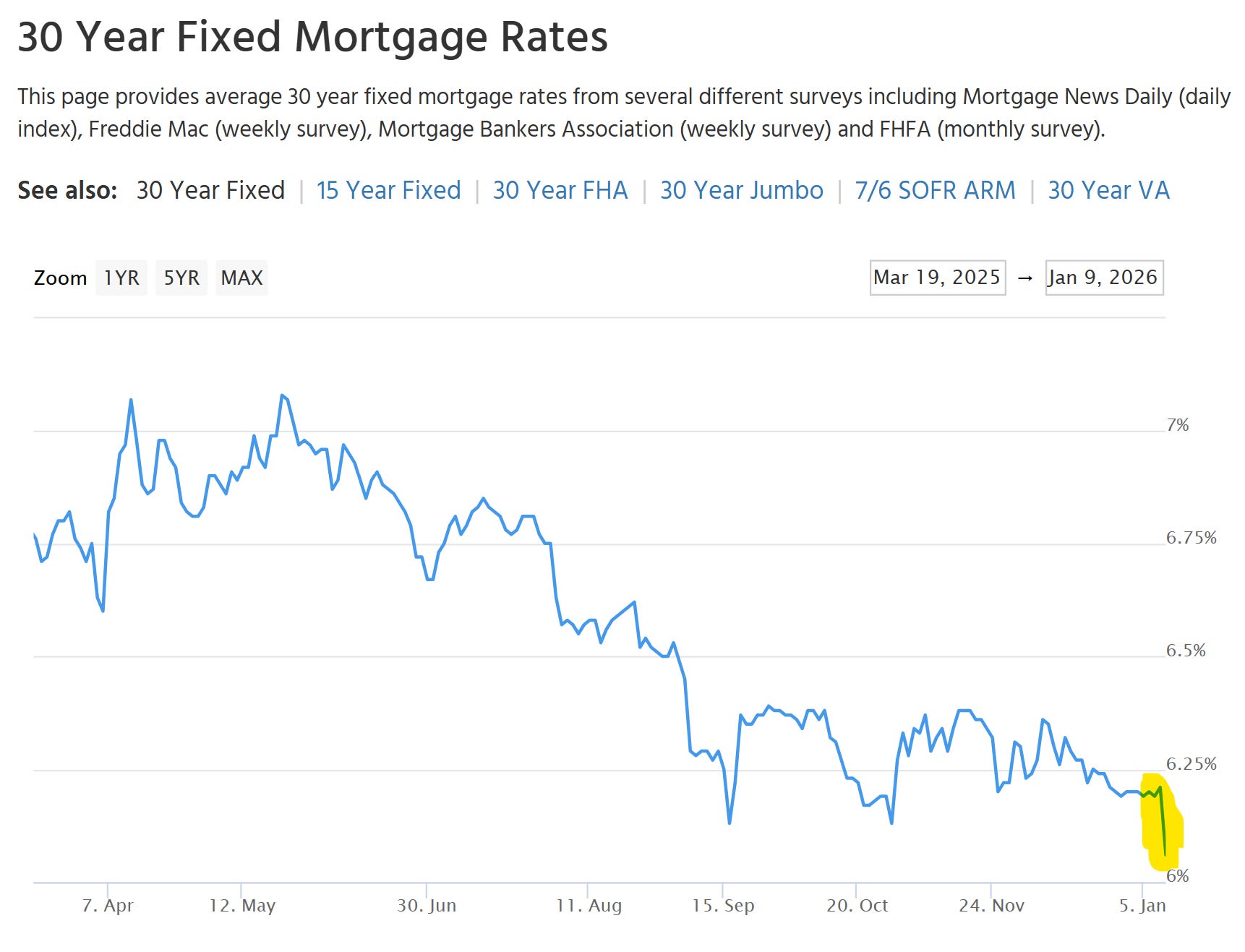
In terms of affordability, however, that’s worse than it looks. No question, a lower rate means lower monthly payments but it also likely puts upward pressure on home prices through the channel of greater demand colliding with near/medium term constrained supply.
But I’ve got a bigger worry. Maybe I’m over my skis a bit on this one, but maybe not. What’s the one thing Trump wants to do in financial markets, besides rip them off for his own benefit? Take your time…I’ll wait.
It’s lowering interesting rates, of course. And given his strong conviction the Fed isn’t doing enough of his bidding in this space, we must worry that he’s found a new route to do so. Moreover, while the GSEs say they’re financing these new purchases out of cash reserves, they could easily turn back to the same borrowing that got them into trouble before the housing bubble burst, i.e., taking advantage of their implicit gov’t backing to borrow at lower rates than the rest of the market.
In other words, I could see Trump looking at the above figure and concluding he’s hacked the Fed.
He would be more wrong than right, because he’s not printing money and therefore, as Peter Schiff warns, there’s a risk that buying more MBS means buying fewer Treasuries (though if they—the GSEs—finance this new buy with short-term Treasuries, they may not push up longer-term yields). But my fear is that once Trump recognizes that he can lower an interest rate, he’ll keep pressing that button until the machine breaks.2
Oil Execs Not Exactly Piling Into Trump’s Venezuelan Deal
Here’s the WaPo headline:

It’s a point I and other have been making for days. When it comes to the U.S. oil majors and Venezuela’s ample reserves, the problem isn’t what under the ground. It’s what’s going on above the ground.
It would take billions to rebuild the infrastructure needed to extract that heavy crude, and perhaps it’s a play some of these companies will eventually want to make. But not before they become a lot more confident that Venezuela’s political instability won’t redound against them, as it has in the past:
CEO Darren Woods said that Venezuela is “uninvestable” after Trump asked him how long it would take the firm to restart operations there. He added that “significant changes have to be made to those commercial frameworks, the legal system, there has to be durable investment protections,” and there needs to be a rewrite of the laws governing oil production in Venezuela.
In his usual mode of making up numbers, Trump claims that “Our giant oil companies will be spending at least $100 billion of their money.” And it is the case that many in corporate America fear the administration to the point that maybe they’ll throw some good money after bad to curry favor with the Orange Menace. But, at this point, they know they’d be guilty of management malpractice were they to commit to significant investments in the highly uncertain oil fields of Venezuela.
The model runs through 2019 and forecasts forward using actual hiring rates.
If you’re thinking that the GSEs have a cap on the amount they can spend on MBS purchases, I assure it’s not the slightest bit binding.
Thank you for prefacing this post with a note about the murder of Renee Good. That's important, and it means a lot, even to this nerdy economist.
I think the dichotomy you outlined in your job market section is pretty stark.
I wouldn’t quite go so far as “unprecedented” (2007 has some similarities) but it is fairly unusual to have a job market that is not just mediocre but downright awful for jobseekers, and pretty good from the perspective of already employed people