
Blockade!
The geopolitics of this move are interesting and worth thinking through. The consumer impacts, on the other hand, are not good and Trump's in denial about his 47.6 problem.

As of 10am ET this morning, the U.S. military is expected to implement a blockade “against vessels of all nations entering or departing Iranian ports and coastal areas.”
As usual, I’m not here to discuss the geopolitics of this move, though I’ll offer a few reflections. I’m here to speak to the domestic economics, which are interesting and reveal an unsurprising miscalculation by the White House.
If you’ve been following these twists and turns, you know that various voices have been calling for a blockade to squeeze Iran’s oil-based income. As Axios points out:
Since the war began, the strait has been selectively closed, with Iran getting to decide who transits through, typically vessels carrying oil and gas to China, Turkey, Pakistan and India…Iran has been exporting more oil during the war than it was before it started…Selective closure has been “one of the perverse outcomes of the war to date” says Edward Fishman, author of “Chokepoints”…
This is, in other words, a strategic move, one that is more familiar in such conflicts than the war crimes Trump was threatening last week. That doesn’t mean it will work and unintended consequences loom. It’s possible, if not likely, that our navy is going to intervene against a Chinese cargo ship. What happens then?
It is also notable that, at least as I write this, the ceasefire is holding, suggesting both sides are looking for an offramp. The question that my paygrade doesn’t cover is whether they can find one. I can’t envision, at this point, a regime change, and the Trumpies have clearly dropped that condition (they were negotiating with the regime). I imagine the Chokepoint of Hormuz reopens at some point, but—and, while obvious, this is a bit of a mindblower—it was open before the war. Which leaves their nuclear program. And I don’t have a clue where that lands.
On to the econ:
As you’d expect, the oil price is up, and pretty sharply, and equity futures are down. As my annotation shows, at least as I write, the current increase only reverses about half the ceasefire-induced decline.
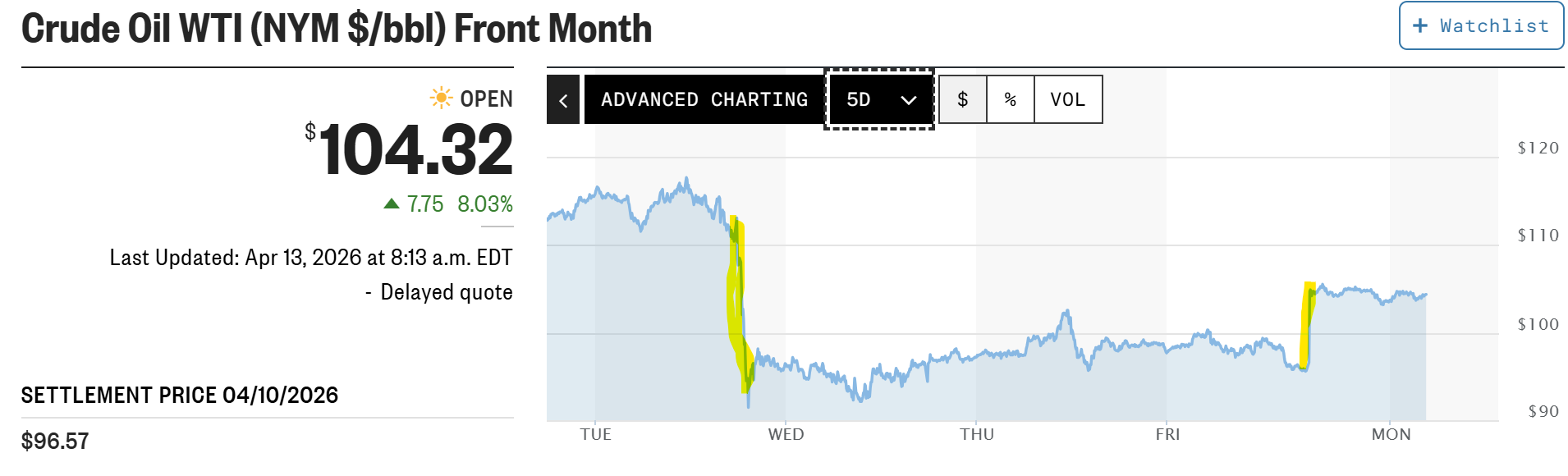
But there’s no denying—even Trump admits it—that the blockade is a play that pits consumers’ affordability discomforts against the Iranian regime’s ability to withstand the pressure. As the WSJ put it, the move “sets off a high-stakes war of attrition that will test who has the higher threshold for pain—Tehran or global markets.”
The problem is, because Trump and his team are so deeply ensconced in their alt reality, they do not understand that they’re operating from a much worse baseline regarding American’s consumer sentiment than they imagine. In a word number, they don’t understand their 47.6 problem that I wrote about yesterday in my weekly wrap-up (that’s the prelim April UMich economic sentiment number, taken pre-ceasefire).
Here’s the POTUS, yesterday:
“I tell my economic advisers, I say, ‘I’m sorry, fellas, we’re in great shape. We have to go and take a little journey down to Iran, and we have to stop them from having a nuclear weapon.’ They all said, ‘We agree.’” Trump also said he wasn’t sure if gasoline prices would retreat before the midterms.
The president envisions the U.S. worker/consumer as doing great, prewar, and therefore onboard for this “little journey” he’s taken us on. But even putting aside the fact that the journey is neither “little” nor rational—again, one of Trump’s main goals is to wrench back the control of the SoH that he essentially gave the Iranians—it’s the “in great shape” part that is the tell.
And, to be clear, there’s no need to over-torque on 47.6, a preliminary monthly number from a noisy series. But the trend is not “in great shape,” hiring in the job market is frozen, inflationary pressures were high before the war, and the combination of slower nominal wage growth and higher inflation is cutting into real wage gains.
In other words, I’m not confident the blockade will work and I worry about its unintended consequences, and I’m horribly and permanently frustrated that these boneheads didn’t think through what they were unleashing. But it is a strategy to pressure Iran, one that has the potential to be effective, and, as noted, it does seem like both sides continue to look for an offramp before restarting hostilities.
That’s geopolitics, and you’d be wise to read others to go deeper. But stay tuned here for how American consumers, who, for the record, are uniquely unenthused by Trump’s Persian Gulf misadventure, are experiencing this war and this ceasefire. They/we went into it with serious affordability concerns, and those concerns are only getting worse.
Iran's leaders will put up with as much suffering in their country as is required. We have elections in November. The TACO truck will arrive before Iran folds.
Well, at least somebody understands this—quote from the NYT: Iran’s top negotiator and the speaker of its Parliament, Mohammad Bagher Ghalibaf, separately warned American consumers: “Soon you’ll be nostalgic for $4–$5 gas.”