
The War and the Pump
Even a normal president would be alarmed by this figure.

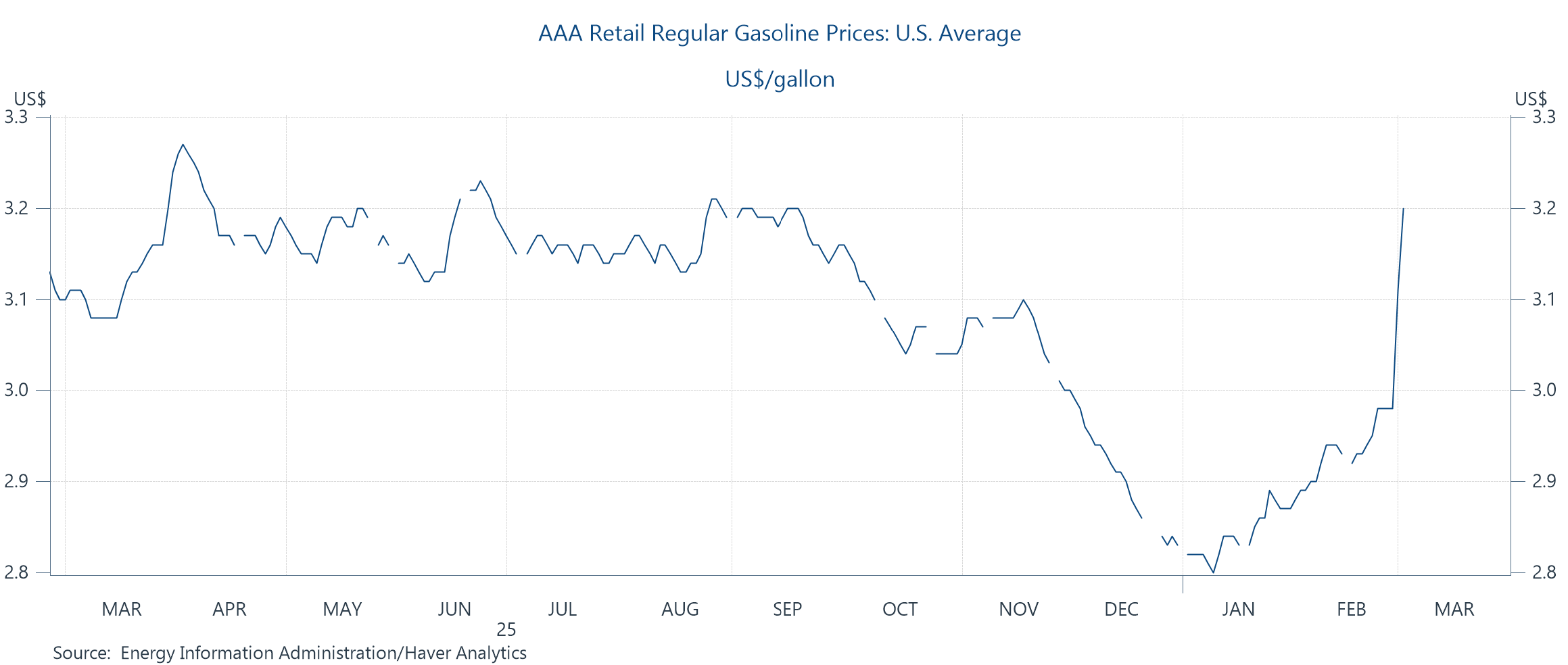
$3.20 a gallon—today’s national gas price—is not that high a price in historical terms. But it’s 40 cents higher than $2.80, where the pump price was a few months ago. A jump of the magnitude you see above is rare, and only happens when there’s some sort of supply shock. Fill up a 15 gallon tank twice a month and that an extra $12, which isn’t game changing for anyone, but is noticeable.
When I left the Obama admin, the President was kind enough to have my family come in for a quick goodbye in the Oval. The gas price was up at the time, and I have a great memory of my nine-year old daughter asking the POTUS why he gets blamed for high gas prices. He gave her that big, broad, Obama smile and said “I know, right?!” I’m pretty sure he high-fived her.
Fact is, the president gets credit and blame for the gas price, which makes about zero economic sense. If ever there was a global price set in global markets—with cartel influence, of course—it’s the oil price. That price is up about $17 since January, and given that a $10 increase corresponds to $0.25 more at the pump, the $0.40 increase is what you’d expect.
In this case, however, the Trump admin’s choice to go to war is behind the spike. The WTI oil price is up about $10 since the war started, and if you’ve followed the developments, you know that there are ongoing disruptions to shipping, production, and refining, and not just for oil but for nat gas too.
I guarantee you this isn’t going unnoticed at the White House and I also guarantee you they’re talking about the Strategic Petroleum Reserve (SPR), the “world’s largest stockpile of emergency crude oil.” The SPR, which is a bit over half-full right now (415 million barrels of ~700mb capacity), was last tapped by the Biden admin when, post-Russia’s invasion of Ukraine, oil topped $100 per barrel. That release, which occurred in sync with that of other countries’ reserves, pretty quickly lowered prices by about $0.35, according to estimates at the time (one wonders if the Trump admin, given their antipathy towards foreign gov’ts, could organize any such multi-country intervention).
The Trump admin says they have no plans to tap the SPR, but I’m skeptical of their claim. As I’ve stressed up here many times, Trump is justly getting clobbered on affordability, as he wavers between saying it’s a hoax and he’s solved it. But the one thing he’s had to tout in this space, and it’s a big one, is the low gas price. Again, even with this recent bump, that price is still low, but if we’ve learned anything about affordability dynamics, it’s that sudden price shocks of key household-market-basket components are a source of economic stress.
As I’ve stressed in discussions of the economics of this new conflict, its impact is a function of its duration. If it ends quickly, I’d expect blocked supply chains to reopen and oil/nat gas production/refinement to recommence pretty quickly.
But when it comes to the gas price, there’s rockets and there’s feathers.
When oil prices shoot upward, gas prices rise with them. And when oil prices fall, gasoline prices also fall; but they can fall at a slower rate. Economists refer to this market dynamic as “asymmetric pass-through.” A more colorful description of the phenomenon is “rockets and feathers.”
The explanation has to do with market power and consumer search patterns. Re the latter, apparently, when the gas price goes up, we tend to exert a bit more effort to search for cheaper options. But when it starts to fall, we’re just happy to see it come down and we don’t search as much, dampening price-reducing competitive forces.
None of this gas-price analysis speaks to the geopolitics of the war. There are, of course, just wars worth fighting regardless of their impacts on prices at home. With 80-90 percent of Iranians anxious to see the toppling of the oppressive theocracy under which they suffered, a few more cents at the pump is arguably worth it. But I don’t see how that’s the case when there’s no plan for a true regime change and an uncomfortably high chance that the power vacuum we and Israel have created is filled by an equally, or even more, repressive regime.
Meanwhile, we’ll see how this plays out in coming days in terms of oil, gas and public opinion. My sense is that a lot of people are thinking this isn’t what they voted for.
I went out to lunch with my my brother’s mother-in-law today (in a rural area of southern England) and she told me she’d got caught in a heavy traffic queue that was lined up to buy petrol. So this is affecting us already. And according to the BBC and The Guardian, natural gas supplies are also about to be curtailed so that’s going to cause price increases in a lot of areas that many Brits can’t afford. I don’t personally know of anyone who isn’t 100% against this war!
"The Trump admin says they have no plans to tap the SPR, but I’m skeptical of their claim."
I am not skeptical. I will never be skeptical of any claim that the Trump administration doesn't have plans.
Now, if they had claimed to have a well-thought-out plan to bring gas prices down, I would be skeptical, whether or not they claimed tapping the SPR was an element of that plan.